Does a salad first make you eat less?
Pick the salad's size and how rich it is, or use your bowl from the builder, and see what the same salad did to a whole lunch in a trial.
12% lessthe whole lunch, against no salad
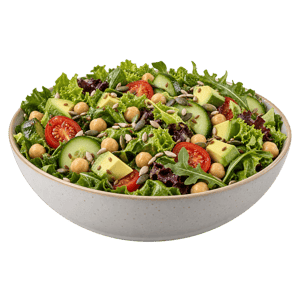
A large, light salad first, about 100 calories of it, and the women ate less pasta after. Lunch came out 12% smaller, salad included.
-12%
300 g, about 100 calories
+17%
300 g, about 400 calories
| Salad first | Whole lunch, against no salad |
|---|---|
| Small and light (150 g, about 50 calories) | 7% less |
| Large and light (300 g, about 100 calories) | 12% less |
| Small and rich (150 g, about 200 calories) | 8% more |
| Large and rich (300 g, about 400 calories) | 17% more |
| In between (0.67 calories per gram) | Not in the published summary |
These were single lunches in a lab, and the women had to finish the salad.
Make it the mealWhat your result means
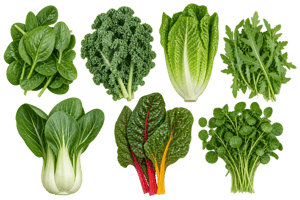
A light salad (under about half a calorie a gram, mostly leaves and vegetables with a teaspoon or so of oil) did its job in the trial: the whole lunch came out smaller. A rich one (cheese, croutons and creamy dressing, over a calorie a gram) made the whole lunch bigger, even though it was the same size bowl. So if your starter lands in the rich row, it's a second meal, not a starter.
Do it once at home: put a big bowl of leaves, tomato and cucumber with a teaspoon of oil in front of dinner for a week and notice how much of the main you serve yourself. If the salad is your whole meal, it has a different job, and the bowl builder grades it as a meal.
The trial
At Penn State, 42 women came in for lunch on seven occasions. Some days they had no first course. On the others they ate a salad first, 150 g or 300 g, at 0.33, 0.67 or 1.33 calories per gram, and they had to finish it. Then came pasta, as much as they wanted.
Against no salad, the light salad cut the whole lunch by 7% when it was small and 12% when it was large. The rich salad, the same size bowl with more and fattier dressing and cheese, raised it by 8% and 17%. The results for the middle salads aren't in the published summary. Each test was a single lunch in a lab.
What we take from it: a salad before a meal works when it's big and light, mostly leaves and vegetables with a little dressing. When the salad is the meal, it has a different job, and the builder grades it as a meal.
1 sources
- Rolls BJ, Roe LS, Meengs JS. Salad and satiety: energy density and portion size of a first-course salad affect energy intake at lunch. J Am Diet Assoc 2004;104(10):1570-1576pubmed.ncbi.nlm.nih.gov