A salad can't keep you full
Short answerNot the way you think
On this page
Not the way you think. A bowl of leaves can’t keep you full, since it’s about 140 calories with 6 g of protein. A salad with your protein line and half a cup of beans can. In a year-long trial, women who ate more water-rich food, mostly vegetables and fruit, lost more weight and said they were less hungry.
What we’d do
If your salad leaves you hungry by three, it’s usually short on protein, calories or both. Add a palm of chicken, a can of tuna or two eggs, then half a cup of chickpeas or black beans, and a tablespoon of olive oil. That turns a 140 calorie bowl of leaves into a 450 calorie lunch that holds. If you’re still hungry after that, look at your breakfast and your sleep.
If you remember three things
- Leaves fill your stomach for a while and give you very little to run on. Three cups of romaine are about 24 calories.
- Protein and beans are what make it last. A palm of chicken has about 27 g of protein, and half a cup of chickpeas about 6 g of fiber.
- The right salad fills you for fewer calories. Women eating more vegetables and fruit in a year-long trial were less hungry and lost more.
Why people believe it
Almost everyone has had the salad lunch that’s gone by mid-afternoon. You ate a big bowl, you felt full when you stood up, and two hours later you were looking for a snack. It’s easy to decide that salads just don’t work.
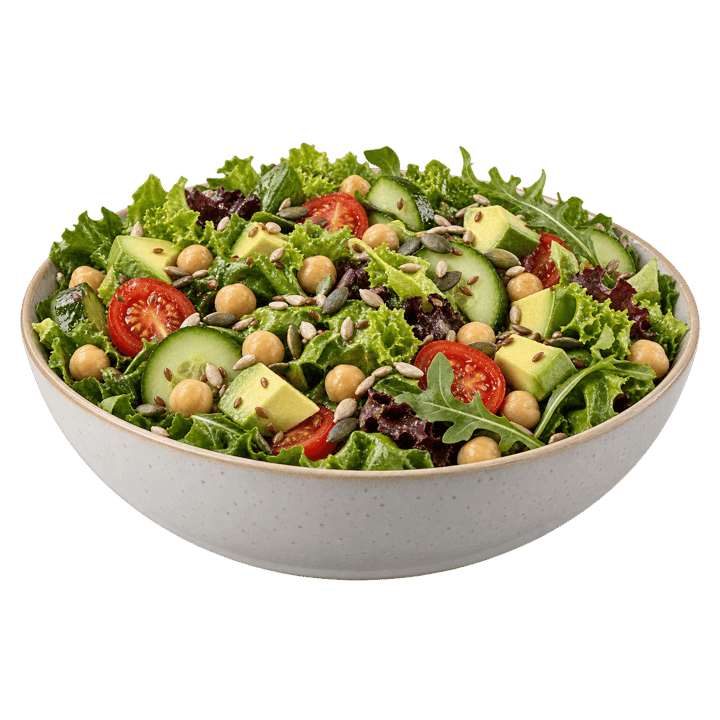
What didn’t work was that bowl. A big bowl of leaves with a few vegetables and a spoon of dressing is about 140 calories with 6 g of protein. It filled your stomach with water for a while, and then there was nothing left to run on.
A bowl of leaves at lunch is like leaving the house with your phone charged to 20%. It looks fine when you set off, and it dies in the middle of the afternoon.
What makes a salad filling
- Protein. A 2015 review of the protein research found people felt fuller after meals with more protein, and pointed to about 25 to 30 g a meal. Leaves have about 1 g a cup.
- Fiber and bulk past the leaves. Half a cup of black beans has about 7.5 g of fiber and chickpeas about 6, where three cups of romaine have about 3.
- Enough calories. On a 2,000 calorie day over three meals, a meal runs about 500 to 830 calories. A 140 calorie bowl is about a quarter of one.
- Some fat. A tablespoon of olive oil adds 119 calories, and it’s what lets you absorb the vitamins in the vegetables.
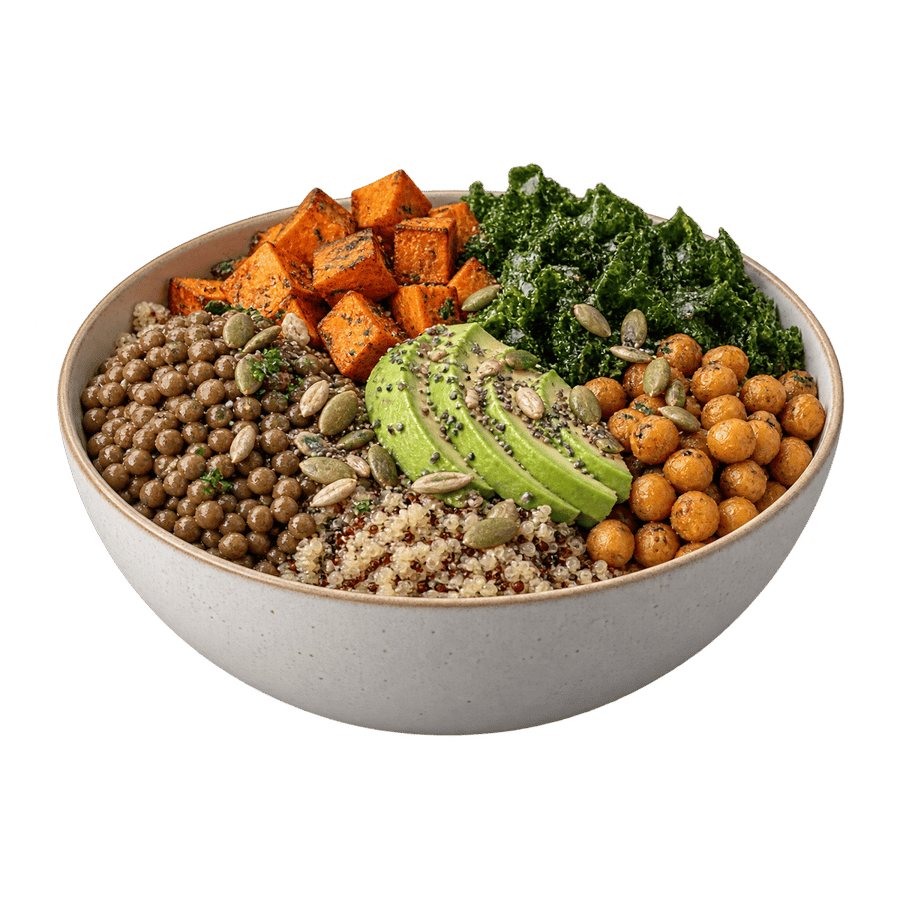
Three bowls, side by side
| Bowl | Calories | Protein | Fiber |
|---|---|---|---|
| 4 cups of romaine, half a cup of carrots, a cup of cucumber, 1 tbsp of Italian | About 139 | 6 g | 6.5 g |
| 3 cups of romaine, a palm of chicken, half a cup of chickpeas, a tomato, half a cup of cucumber, 1 tbsp of olive oil with vinegar | About 453 | 39 g | 11 g |
| 3 cups of spinach, a cup of chickpeas, half a cup of quinoa, a tomato, 1 tbsp of olive oil | About 546 | 23 g | 19 g |
The first bowl is the one that leaves you hungry. The second is the one we’d make for lunch, and it grades A+ on the bowl builder for a 170 lb person. The third has no meat and a lot of fiber, and it’s a B+. At 23 g of protein it lands under the Muscle line, so it can’t be an A however good the rest is, and a can of tuna or two eggs would close the gap.
What the trials found
A year of eating more vegetables
97 women with obesity, Penn State, 2007. Ello-Martin and colleagues
One group was told to eat less fat, the other less fat and more water-rich foods, mostly vegetables and fruit. Of the 71 who finished, the vegetable group lost about 17 pounds (7.9 kg) against about 14 (6.4 kg), “reported less hunger”, and ate a greater weight of food.
Women with obesity, no calorie targets, and about a quarter dropped out.
A light salad before lunch
42 women, Penn State, 2004. Rolls, Roe and Meengs
A large light salad before a pasta lunch cut the whole meal by 12%, so the salad filled them enough to eat less pasta.
Single lunches in a lab, and the salad was a starter, not the meal.
Protein and fullness
A review of the protein research, 2015. Leidy and colleagues
People felt fuller after higher-protein meals, and the review pointed to at least about 25 to 30 g a meal.
In short trials, people didn’t eat less at the next meal.
The best case for the myth
“I’ve built a proper salad with chicken and beans and I’m still starving by four.” It happens. Hunger isn’t only about one meal, and your breakfast, your sleep and the rest of your day all play a part. bodyfat.guide’s chapter on hunger covers sleep and the other things that change how hungry you are. If the salad has your protein, a fiber food and enough calories, look there next.
4 sources
- Ello-Martin et al., Dietary energy density in the treatment of obesity: a year-long trial comparing 2 weight-loss diets, American Journal of Clinical Nutrition, 2007pubmed.ncbi.nlm.nih.gov
- Leidy et al., The role of protein in weight loss and maintenance, American Journal of Clinical Nutrition, 2015pubmed.ncbi.nlm.nih.gov
- Rolls, Roe and Meengs, Salad and satiety: energy density and portion size of a first-course salad affect energy intake at lunch, Journal of the American Dietetic Association, 2004pubmed.ncbi.nlm.nih.gov
- Gebhardt and Thomas, Nutritive Value of Foods, Home and Garden Bulletin 72, USDA Agricultural Research Service, 2002ars.usda.gov