Why does salad make me bloated?
Usually the gas comes from the beans, the raw cabbage, broccoli or kale on top, or a lot more fiber than your gut is used to, and the lettuce has little to do with it. The bacteria in your large intestine break down the carbohydrates your small intestine can’t, and they make gas while they do it. Some gas after a meal is normal. If a big salad leaves you uncomfortable, build up to it over a few weeks and swap the worst offenders.
People often switch to a big salad lunch to eat better, and a day later they feel like a balloon. It’s easy to blame the lettuce, since it’s the biggest thing in the bowl. Lettuce is mostly water, though, with about 1 g of fiber a cup. The parts that make gas are the healthy add-ons this site keeps telling you to use.
What we’d do
Keep the salad and change what’s in it for a while. Start with a quarter cup of beans or chickpeas instead of half a cup, and add more every week or so. Use romaine, spinach or butter lettuce as the base, and go easy on raw cabbage, broccoli and kale until you’re settled, or cook them. Eat slowly, and if the bowl is huge, split it into two smaller meals. If the bloating comes with pain or changes suddenly, see a doctor.
Which parts of a salad make gas
The NIH’s digestive disease institute (NIDDK) lists the foods most likely to cause gas. The ones that end up in a salad are beans, peas and lentils, cruciferous vegetables (it names broccoli, cauliflower, collard greens and kale, and cabbage is in the same family), some fruit like apples and pears, dairy like milk and yogurt, and whole grains. It also says some people get more gas from too much fiber at once, and that high-fat foods can make bloating worse.
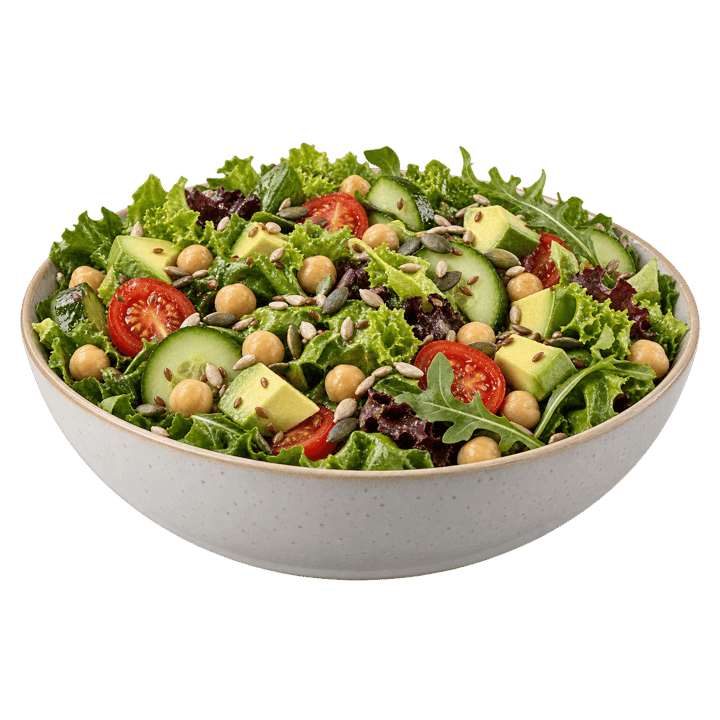
Here’s how that looks in a typical meal salad, counted from the USDA rows the bowl builder uses. Three cups of romaine have about 3 g of fiber. Half a cup of chickpeas adds about 6 g, and half a cup of black beans about 7.5 g. A cup of raw shredded cabbage adds about 1.5 g. So a bowl built the way we recommend can have 10 to 12 g of fiber, more than the 9 g or so a meal’s share of the fiber line comes to on a 2,000 calorie day. That’s good for you, and your gut may need a few weeks to get used to it.
How to build up to a big bowl
Think of it like starting to run. Nobody goes from the couch to 10 miles in one day, and we’d add fiber the same way, a little more each week, so you can see what your gut handles.
- Start the beans small. A quarter cup for the first week or two, then half a cup.
- Choose softer greens. Romaine, spinach and butter lettuce are mostly water. Raw kale and cabbage are tougher, and they’re cruciferous.
- Cook the cruciferous ones, or leave them out for a few weeks and bring them back.
- Keep the dressing to a spoon or two. A tablespoon of olive oil helps you absorb the vegetables’ vitamins, but a heavy, fatty bowl can add to the bloat.
- Eat slowly. NIDDK lists eating slowly, sitting down to eat, and smaller, more frequent meals among the habit changes doctors suggest for gas.
If you’re on a GLP-1 drug like Ozempic or Mounjaro, bloating and fullness are common side effects of the drug itself, since it slows your stomach. Salad on a GLP-1 has the smaller bowl for that.
When it’s more than a salad
Having some gas, especially during or after meals, is normal, and NIDDK says people typically belch up to 30 times a day. Gas becomes a problem when it happens often, bothers you, or affects your daily activities. NIDDK says to talk with your doctor if gas bothers you, if your symptoms change suddenly, or if they come with belly pain, constipation, diarrhea or weight loss. They may ask you to keep a diary of what you eat and your symptoms, which NIDDK also suggests, to find the food that sets it off.
4 sources
- NIDDK, Eating, diet and nutrition for gas in the digestive tract, US National Institutes of Healthniddk.nih.gov
- NIDDK, Symptoms and causes of gas in the digestive tract, US National Institutes of Healthniddk.nih.gov
- Gebhardt and Thomas, Nutritive Value of Foods, Home and Garden Bulletin 72, USDA Agricultural Research Service, 2002ars.usda.gov
- Mozaffarian et al., Nutritional priorities to support GLP-1 therapy for obesity: a joint advisory, Obesity Pillars, 2025pmc.ncbi.nlm.nih.gov