Salad on Ozempic, Wegovy or Mounjaro: how to build the bowl
On this page
On a GLP-1 drug like Ozempic, Wegovy, Mounjaro or Zepbound, a salad is one of the best meals you can eat and one of the easiest to get wrong. It packs a lot of vitamins into few calories, which is what you need when you’re eating less. But a big bowl of raw leaves can fill a slow stomach before you reach the protein. Build a smaller bowl, eat the protein first, go easy on raw roughage in the first weeks, and keep a measured spoon of oil.
If you want to and can, the same bowl built as a full meal helps you lose weight without a drug, and salad and weight loss shows how.
People starting a GLP-1 often reach for salad because it feels like the safe, light choice. Then the bowl sits in their stomach for hours, or they feel sick halfway through, or they stop eating after the lettuce and the chicken goes in the fridge. The drug is doing what it’s meant to do. It slows how fast your stomach empties, which the advisory names as the cause of the bloating, fullness and nausea, and it turns down your appetite, so the meal that worked before is now too big, and the order you eat it in starts to count.
What we’d do
Make the bowl smaller and turn it around so it’s protein first, then vegetables, then leaves. Put a palm of salmon or chicken or a can of tuna on about two cups of greens with a tomato and half a cup of chickpeas, and eat the protein before the leaves. In the first weeks, or after a dose goes up, use softer greens like spinach or butter lettuce and fewer raw cabbage, kale and broccoli pieces, and add them back as you settle. Keep one tablespoon of olive oil on it, measured, since the vitamins in the vegetables need some fat, and skip creamy dressings and fried toppings. Raise any side effect that worries you with your prescriber.
Why the big salad stops working
Think of your stomach as a sink with the drain half closed. The same pour that used to run straight through now fills it up. GLP-1 drugs slow the drain, so a meal stays in your stomach longer, and the volume of the meal becomes the limit long before the calories do.
A classic big salad is exactly that, a lot of volume for very few calories. Romaine is about 95% water, so four cups of leaves fill you like a meal and bring about 30 calories. Before the drug, that’s a nice trick for eating less. On the drug, you may already be eating 16 to 39% less, the range a 2025 joint advisory from four US obesity and nutrition societies gives, and the leaves crowd out the food that protects your muscle while you lose weight.
The same advisory lists the side effects from the big trials. On semaglutide 2.4 mg (Wegovy), 44% of people had nausea against 16% on placebo, and 24% had constipation against 11%. On tirzepatide 15 mg (Zepbound), 25% had nausea against 8%. The side effects are most common in the first weeks and after each dose increase, and they usually ease on a stable dose.
Build the smaller bowl
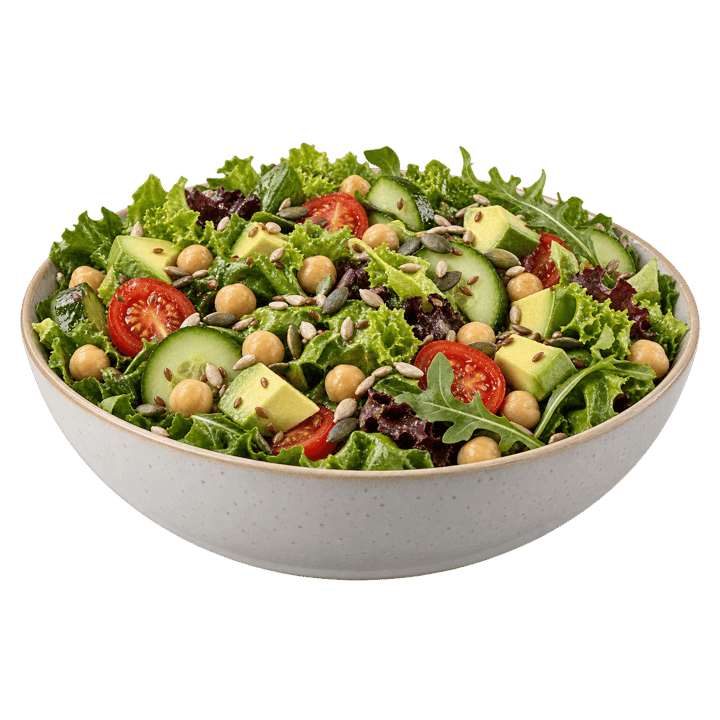
The six meters still apply, but your plate is smaller, since your day is. Here are two bowls graded for someone eating about 1,400 calories a day over three meals. The big bowl is a fine meal for a normal day and a B+ here, because at about 780 calories it’s more than half of the whole day. The smaller one is an A.



The smaller bowl
2 cups spinach, 1 palm salmon, ½ cup chickpeas, 1 tomato, 1 tbsp olive oil, 1 tbsp lemon juice
480 calories, 33 g protein, 9.4 g fiber, dressing 25%, sodium 120 mg


The big bowl
4 cups romaine, 2 cups spinach, 1 palm salmon, 1 cup chickpeas, 1 tomato, 1 cup cucumber, 2 tbsp olive oil
780 calories, 46 g protein, 20.3 g fiber, dressing 31%, sodium 140 mg
- Protein first, about 25 to 35 g. The advisory notes that 1.2 to 1.6 g of protein per kg a day has been proposed during active weight loss, the same range the 2025 to 2030 US guidelines give for everyone. A palm of salmon or chicken or a can of tuna covers most of a meal. Eat it first, so it’s in you before you feel full. protein.guide has the GLP-1 protein numbers and why lifting twice a week protects the muscle.
- Fewer, softer leaves. Two cups instead of four or five. Spinach and soft lettuces are gentler than raw kale, cabbage or broccoli, which the NIH lists among the vegetables that make gas, and the advisory suggests avoiding high-fiber foods in the first few days of treatment when nausea is the problem.
- One fiber food, once you’re settled. Half a cup of chickpeas or beans brings about 6 g of fiber. Constipation is common on these drugs, and the advisory’s advice is fluids and fiber from food, so bring it back steadily once the early nausea passes.
- A measured spoon of oil. One tablespoon of olive oil with lemon or vinegar. Large or high-fat meals can make diarrhea and nausea worse, so skip the creamy dressing, bacon and fried toppings. But don’t go fat-free: with fat-free dressing, almost none of the carotenoids in the vegetables reached people’s blood in a 2004 trial, and that’s vitamin A you can’t spare when you’re eating less.
- Small and more often if you feel sick. The advisory suggests smaller, more frequent meals and enough fluids. Half the bowl now and half in three hours is fine.
What this is and isn’t
This page is about building a salad, and nothing here changes your dose or replaces your prescriber’s advice. The advisory warns that severe vomiting or diarrhea can dehydrate you and strain the kidneys, so raise it with your care team quickly. If you have type 2 diabetes and take insulin or a sulfonylurea, low blood sugar can happen on these drugs, so ask your doctor how to adjust as you eat less. glucose.guide explains the diabetes medicines, and bodyfat.guide covers what to expect from the drugs themselves.
The numbers behind it
The 2025 advisory is the clearest summary of nutrition on these drugs so far, written by the American College of Lifestyle Medicine, the American Society for Nutrition, the Obesity Medicine Association and the Obesity Society. It’s a review of the trials and practice guidance, so its food advice is expert consensus rather than trial results for each tip. Nobody has tested salad on a GLP-1 in a trial. The bowl here applies what the advisory says (protein, fluids, fiber from food, smaller meals, fewer high-fat meals) to the meal this site knows best.
You can put your own bowl into the bowl builder, set your calories a day to what you’re eating now, and see which meters it clears. The Gyroscope app personalizes your protein line.
5 sources
- Mozaffarian et al., Nutritional priorities to support GLP-1 therapy for obesity: a joint advisory from the American College of Lifestyle Medicine, the American Society for Nutrition, the Obesity Medicine Association, and the Obesity Society, Obesity Pillars, 2025pmc.ncbi.nlm.nih.gov
- Brown et al., Carotenoid bioavailability is higher from salads ingested with full-fat than with fat-reduced salad dressings as measured with electrochemical detection, American Journal of Clinical Nutrition, 2004pubmed.ncbi.nlm.nih.gov
- US Department of Agriculture and US Department of Health and Human Services, Dietary Guidelines for Americans, 2025 to 2030, January 2026cdn.realfood.gov
- NIDDK, Eating, diet and nutrition for gas in the digestive tractniddk.nih.gov
- Gebhardt and Thomas, Nutritive Value of Foods, Home and Garden Bulletin 72, USDA Agricultural Research Service, 2002ars.usda.gov