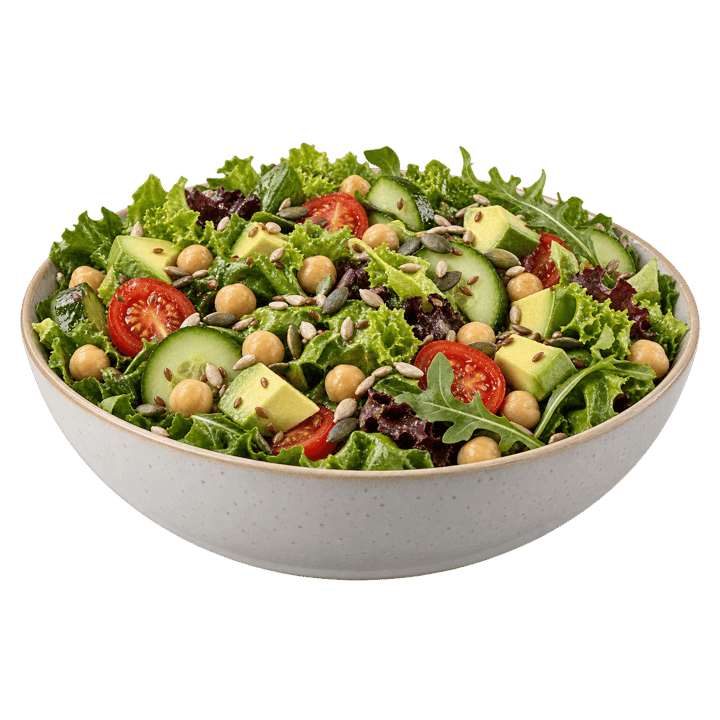
Protein on a salad
On this page
Most people need about 25 to 35 g of protein at a meal, and leaves have almost none. A palm of chicken or a can of tuna gets you there for about 135 to 160 calories. Cheese takes about 490 calories for the same 30 g, and beans take two cups, so pair them with an egg, tofu or cottage cheese.
What we’d do
Put a protein you can see on every meal salad. A palm of grilled chicken or fish, or a can of tuna, covers most people’s line by itself. Without meat, use two protein foods, like chickpeas with two eggs, or tofu with beans. Treat cheese, nuts and seeds as toppings for flavor. They have some protein, and a lot more fat.
If you remember three things
- Your line is about 30 g if you weigh 170 lb and eat three meals. About 25 at 140 lb and 35 at 200.
- Tuna and chicken are the cheapest protein in calories. Cheese costs about three times as much as chicken for the same 30 g.
- Beans alone take two cups to reach 30 g. Half a cup with a second protein food is easier to eat.
Why your salad has less protein than you think
A salad with cheese, nuts and a sprinkle of seeds feels like it has protein in it, and the label on a bag of almonds says it does. But a meal’s protein comes from how much is there, and a sprinkle isn’t much.
Three cups of romaine have about 3 g of protein. A caesar with croutons and parmesan has about 10 g. A side salad has about 3. The salad with a palm of grilled chicken on it has about 32, and that’s the one that gets you to dinner.
Your line at a meal
The 2025 to 2030 US guidelines set protein at 1.2 to 1.6 g per kg of body weight a day and say “Prioritize Protein Foods at Every Meal”. We take the low end, 1.2 g, split it over your meals and round to the nearest 5. That’s the meal line meals.guide and the other guides use.
| You weigh | Your line at three meals | At two meals |
|---|---|---|
| 140 lb | 25 g | 40 g |
| 170 lb | 30 g | 45 g |
| 200 lb | 35 g | 55 g |
The Gyroscope app personalizes yours. For your whole day as a range, bodyfat.guide’s protein calculator has it.
A 2015 review of the protein research landed in the same place. The authors wrote that diets that help with appetite and weight “potentially include meal-specific protein quantities of at least ∼25-30 g protein/meal”. In short feeding trials, people felt fuller after the higher-protein meals. They didn’t eat less at the next meal, so the effect is on how full you feel, and it’s modest.
What 30 g of protein costs
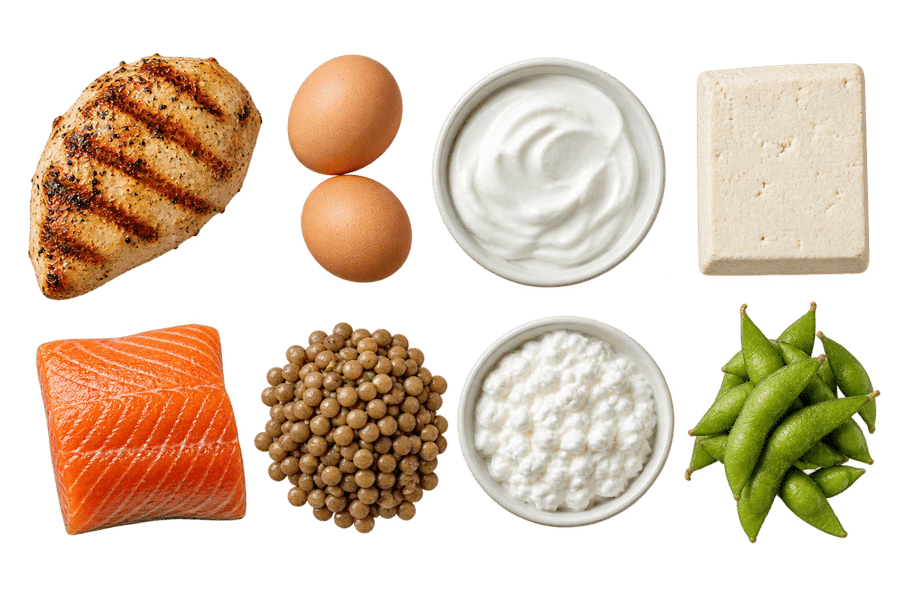
Think of calories as the price you pay for your protein. Some foods sell it cheap and some sell it with a lot of fat attached. Here’s what it takes to reach 30 g, from the USDA food tables the bowl builder uses.
| Food | How much for 30 g | Calories |
|---|---|---|
| Tuna, canned | 4.1 oz (116 g) | 135 |
| Shrimp | 4.2 oz (120 g) | 143 |
| Chicken breast | 3.4 oz (96 g) | 158 |
| Steak | 3.5 oz (98 g) | 192 |
| Salmon | 3.9 oz (111 g) | 240 |
| Cottage cheese | 1.2 cups (242 g) | 250 |
| Firm tofu | about 12 oz (347 g) | 266 |
| Lentils | 1.7 cups (330 g) | 383 |
| Eggs | 5 large | 390 |
| Black beans | 2 cups (344 g) | 454 |
| Cheddar | 4.2 oz (120 g) | 489 |
| Chickpeas | 2 cups (328 g) | 538 |
The tofu row uses USDA’s firm tofu at 8.6 g of protein per 100 g. Tofu labels vary a lot from brand to brand, so check the grams of protein on yours before you count on it.
The protein ladder redraws this table for your own weight and meals, and drops any row into the bowl builder.
Why cheese is a fat with some protein in it
An ounce of cheddar has 7 g of protein and 9 g of fat. To get 30 g of protein from it you’d eat more than 4 oz, about 490 calories, three times what chicken costs. An ounce of almonds has 6 g of protein and 14 g of fat, and sunflower seeds are about the same.
None of that makes cheese or nuts bad on a salad. An ounce of feta or a small handful of almonds adds flavor and crunch, and neither can carry the protein on its own. In the bowl builder, a salad with feta and almonds and no chicken, fish, eggs, tofu or beans has about 14 g of protein and misses the Muscle line, so it can’t be an A.
Without meat
Beans and lentils are good protein foods, and they’re also mostly carbohydrate and fiber, so it takes a lot of them. Two cups of black beans reach 30 g at about 454 calories, which is a big bowl of beans. Two protein foods at half the line each are easier.
Here are three meatless bowls through the bowl builder, each on 3 cups of greens with a tomato and a tablespoon of olive oil with vinegar.
Chickpeas and eggs
A cup of chickpeas and two hard-boiled eggs. About 596 calories
31 g of protein and 17 g of fiber. A+.
The biggest of the three, so it suits a long afternoon.
Tofu and chickpeas
About 8½ oz of firm tofu (243 g) and half a cup of chickpeas. About 501 calories
34 g of protein and 12 g of fiber. A+.
With a higher-protein tofu, you’d need less.
Cottage cheese and chickpeas
A cup of cottage cheese and half a cup of chickpeas, with half a cup of cucumber. About 529 calories
38 g of protein and 11 g of fiber. A+.
Cottage cheese is salty, about 850 mg of sodium a cup.
When you can only eat a small bowl
If you’re on a GLP-1 drug, or you just aren’t very hungry at lunch, you may not finish a big salad. Put the protein on the plate first and eat it first, and let the leaves be the part you leave. bodyfat.guide’s GLP-1 guide covers protein on those drugs.
The best case against counting protein at lunch
“The review found people didn’t eat less at the next meal, so what’s the point?” That’s a fair point. The short trials mostly measured fullness and the next meal, and the next meal didn’t shrink. But the same review tied higher-protein diets to improvements in appetite and weight management, and the 2025 to 2030 guidelines ask for protein at every meal. A salad with no protein is also a salad that needs a snack at four, and we’d rather put the protein in the bowl.
4 sources
- US Department of Agriculture and US Department of Health and Human Services, Dietary Guidelines for Americans, 2025 to 2030cdn.realfood.gov
- Leidy et al., The role of protein in weight loss and maintenance, American Journal of Clinical Nutrition, 2015pubmed.ncbi.nlm.nih.gov
- Gebhardt and Thomas, Nutritive Value of Foods, Home and Garden Bulletin 72, USDA Agricultural Research Service, 2002 (the protein ladder's food values, firm tofu item 728)ars.usda.gov
- USDA Standard Reference, lettuce, cos or romaine, rawnutritionvalue.org