Salad and weight loss
On this page
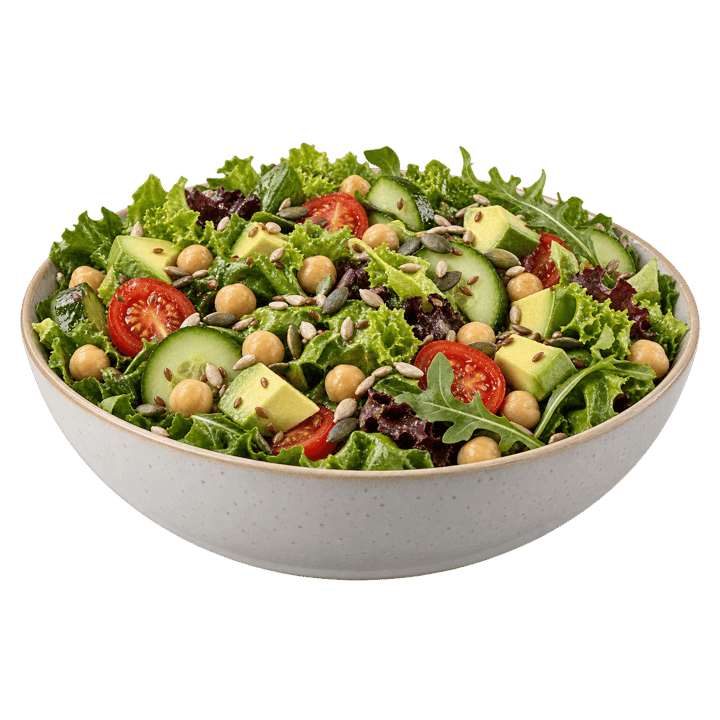
Salad helps you lose weight when it’s a real meal that fills you for fewer calories than what it replaces. In a year-long trial, women who ate more vegetables and fruit lost about 17 pounds against 14 and felt less hungry. A bowl of leaves at lunch backfires, and so does a 700 calorie restaurant salad.
What we’d do
Make one meal a day a big salad built like a meal. That means your protein line, half a cup of beans or grains, as many vegetables as you like and a tablespoon of olive oil, sized to your plate. Measure the dressing with a spoon for two weeks, and don’t make lunch a bowl of leaves, since you’ll eat the difference by four. Set your day’s calories on tdee.guide first, so you know what a meal should be.
If you remember three things
- Water-rich food helped women lose more and feel less hungry. They ate a greater weight of food and still lost more.
- A bowl of leaves is too small to be lunch. About 140 calories with 6 g of protein is a snack.
- The dressing is where the calories hide. A ladle of olive oil over a spoon of it is about 360 calories more.
Why salads work for some people and backfire for others
When people decide to lose weight, a lot of them start eating salads at lunch. Some lose weight and some don’t, and usually it’s because they’re eating one of two very different salads.
The first is the bowl of leaves, with 4 cups of romaine, some carrots and cucumber and a tablespoon of bottled Italian, about 140 calories with 6 g of protein. It looks virtuous, and by mid-afternoon the vending machine wins. The second is the restaurant salad, like a cobb with 3 tablespoons of ranch at about 707 calories, or a chicken caesar with 3 tablespoons of dressing at about 581. Both are salads, and neither is the salad that helps.
The year-long trial
In 2007, researchers at Penn State put 97 women with obesity on one of two diets for a year. One group was told to eat less fat. The other was told to eat less fat and more water-rich foods, mostly vegetables and fruit. Neither group had a calorie target.
Of the 71 women who finished, the vegetable group lost about 17 pounds (7.9 kg) and the fat-only group about 14 (6.4 kg). The vegetable group “reported less hunger”, and they ate a greater weight of food than the other group did, mostly from the extra vegetables and fruit. They ate more food and lost more weight.
Both groups lost weight, and the gap between them was about 3 pounds over a year, which is useful and not dramatic. About a quarter of the women dropped out before the year was up.
How it works
The key number is energy density, the calories in a gram of food. Water has none, and fat has the most.
| Food | Calories per gram |
|---|---|
| Romaine | 0.14 |
| Chickpeas | 1.6 |
| Grilled chicken breast | 1.7 |
| Cheddar | 4.1 |
| Croutons | 4.7 |
| Olive oil | 8.5 |
Energy density is like the price per pound at the grocery store. Lettuce is so cheap that a big bag of it costs almost nothing. Oil is the expensive stuff, so you buy it by the spoon. A salad lets you fill a big bowl with cheap food, as long as the expensive parts stay small.
The same idea runs through the whole bowl. Our lunch bowl, with chicken, chickpeas and a tablespoon of oil, comes to about 0.84 calories per gram. A caesar with 3 tablespoons of dressing and croutons is about 1.8, more than twice as dense, so the same size bowl carries twice the calories.
Why a bowl of leaves at lunch fails
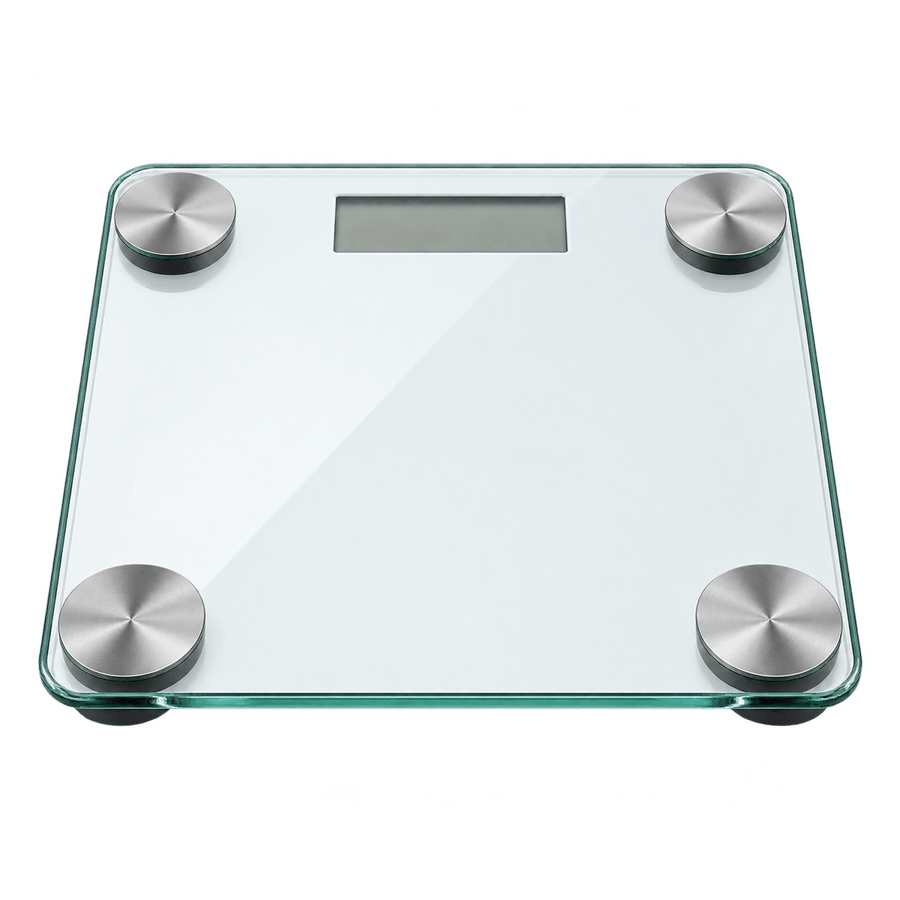
A bowl of leaves fills your stomach for an hour and gives you almost nothing to run on. At about 140 calories and 6 g of protein, it’s about a quarter of a meal on a 2,000 calorie day split over three meals, where a meal runs about 500 to 830. Hunger at three is your body asking for the rest, and the snack that answers it is rarely a salad.
A 2015 review of the protein research found people felt fuller after meals with more protein, and pointed to about 25 to 30 g a meal. Leaves don’t come close. Put a palm of chicken on that same bowl and it’s about 280 calories with 32 g of protein, which is a light lunch that will hold. The salad that’s a meal has the four parts.
Your plate when you’re losing weight
A meal’s size comes from your day. Take your day’s calories, divide by your meals, and allow a quarter either side.
| Your day | Over three meals, each meal |
|---|---|
| 1,600 calories | About 400 to 670 |
| 1,800 calories | About 450 to 750 |
| 2,000 calories | About 500 to 830 |
On 1,600 calories, our lunch bowl at about 450 sits right in the middle, and a cobb at 707 is past the top. Swapping that cobb for the lunch bowl saves about 250 calories a day without making lunch smaller to look at. tdee.guide works out your day’s number to lose weight, and the bowl builder shows where your salad sits.
Measure the dressing for two weeks
The difference between a spoon and a ladle is the biggest swing in a salad. A tablespoon of ranch is about 64 calories and a 2 oz ladle about 256. A tablespoon of olive oil is 119 and a ladle about 476. Measure it for two weeks and your eye learns what a tablespoon looks like on your leaves. The pour shows how much of your bowl the dressing is at each amount.
Don’t cut the oil to nothing to save calories. Your salad needs some fat for you to absorb the vitamins in the vegetables, and the dressing chapter has the trials.
The best case against salad for weight loss
“Weight is calories in and calories out. A salad does nothing a smaller dinner wouldn’t do.” That’s right about the calories. Salad doesn’t burn fat, and bodyfat.guide explains why the gap between what you eat and what you burn is what moves your weight. But the hard part of eating less is being hungry while you do it, and in the year-long trial the group eating more vegetables said they were less hungry while losing more. A big salad built like a meal is one of the easier ways to eat less without feeling it.
If you take warfarin and start eating a big salad every day, keep the amount of leafy greens steady week to week. Vitamin K changes how warfarin works, so talk to your doctor before a big change.
6 sources
- Ello-Martin et al., Dietary energy density in the treatment of obesity: a year-long trial comparing 2 weight-loss diets, American Journal of Clinical Nutrition, 2007pubmed.ncbi.nlm.nih.gov
- Rolls, Roe and Meengs, Salad and satiety: energy density and portion size of a first-course salad affect energy intake at lunch, Journal of the American Dietetic Association, 2004pubmed.ncbi.nlm.nih.gov
- Leidy et al., The role of protein in weight loss and maintenance, American Journal of Clinical Nutrition, 2015pubmed.ncbi.nlm.nih.gov
- Gebhardt and Thomas, Nutritive Value of Foods, Home and Garden Bulletin 72, USDA Agricultural Research Service, 2002ars.usda.gov
- USDA Standard Reference, salad dressing, ranch dressing, regularnutritionvalue.org
- MedlinePlus, Warfarin, US National Library of Medicine, checked 2026-11-14medlineplus.gov