Which greens?
On this page
Per cup, spinach has the most vitamin K, romaine the most folate and vitamin A, and kale the most vitamin C. Weighed per 100 g, spinach leads on almost everything and kale on vitamin C and fiber. No single green wins, so rotate them, and if you take warfarin, keep the amount steady.
What we’d do
Use romaine or spinach as the base, since they give you the most per cup and you can eat three cups of either without trying. Add a handful of kale or arugula for bite. Change the mix from week to week. Iceberg is fine for crunch, mixed in with a darker green. And skip paying extra for a “superfood” green, since the plain heads in the produce aisle hold up well.
If you remember three things
- A cup is a measure of space. A cup of chopped kale weighs 21 g, spinach 30, romaine 47 and iceberg 72, so the winner changes with how you count.
- Plain romaine beats kale per cup on folate and vitamin A. It has about five times kale’s folate and four times its vitamin A.
- On warfarin, keep it steady. Vitamin K changes how warfarin works, so eat about the same amount of greens each week.
Why kale got the crown
Kale has a reputation as the healthiest thing in the produce aisle. Per 100 g it’s very strong, with about three times spinach’s vitamin C and nearly twice its fiber. Most nutrition charts list values per 100 g, which makes kale look like the clear winner.
But nobody fills a salad bowl on a kitchen scale. You fill it by the cup, or by the handful, and greens pack into a cup very differently. Curly kale leaves leave big gaps. Spinach leaves lie flat, and iceberg is dense and wet.
Comparing greens by the cup is like comparing pillows by the size of the case. A cup of chopped kale is mostly air between the curls. To eat 100 g of raw kale you’d need almost 5 cups of it, and for spinach about 3⅓.
Per cup, the way you eat them
| Green | A cup weighs | Calories | Vitamin K | Folate | Vitamin A | Vitamin C | Fiber |
|---|---|---|---|---|---|---|---|
| Spinach | 30 g | 7 | 145 mcg | 58 mcg | 141 mcg | 8.4 mg | 0.7 g |
| Kale | 21 g | 7 | 82 mcg | 13 mcg | 51 mcg | 19.6 mg | 0.9 g |
| Romaine | 47 g | 8 | 48 mcg | 64 mcg | 205 mcg | not listed | 1 g |
| Arugula | 20 g | about 5 | about 22 mcg | not listed | not listed | not listed | not listed |
| Iceberg | 72 g | 10 | 17 mcg | 21 mcg | 18 mcg | 2 mg | 0.9 g |
Folate is in mcg DFE and vitamin A in mcg RAE, the units USDA uses. The arugula values are scaled from small portions, so they’re rough.
Per 100 g, the way charts list them
| Green | Vitamin K | Folate | Vitamin A | Vitamin C | Fiber |
|---|---|---|---|---|---|
| Spinach | 483 mcg | 193 mcg | 470 mcg | 28 mg | 2.2 g |
| Kale | 390 mcg | 62 mcg | 243 mcg | 93 mg | 4.1 g |
| Romaine | 103 mcg | 136 mcg | 436 mcg | not listed | 2.1 g |
| Iceberg | 24 mcg | 29 mcg | 25 mcg | 2.8 mg | 1.2 g |
Weight for weight, spinach beats kale on vitamin K, folate and vitamin A, and kale beats spinach on vitamin C and fiber. By the cup, romaine moves up to first on folate and vitamin A, because a cup of romaine weighs more than twice a cup of kale. Greens compared lets you flip between the two and sort by each one.
What each green is good for
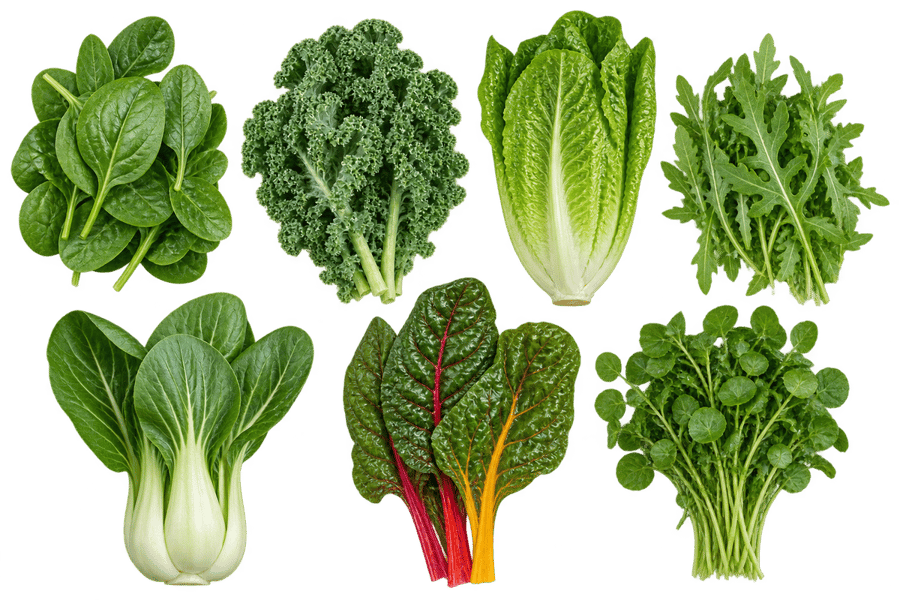
- Spinach is the vitamin K leader by any measure, and strong on folate and vitamin A. A cup is 7 calories.
- Romaine gives you the most folate and vitamin A per cup, and the most fiber per cup of the four. It’s also the base most people will eat three cups of.
- Kale wins on vitamin C, about 20 mg a cup, and has 53 mg of calcium a cup. It’s tough raw, so it’s easier as a handful mixed in.
- Arugula is light and peppery, about 5 calories a cup.
- Iceberg is about 96% water. It’s the crunchiest and the lowest in vitamins, and it still counts as a vegetable.
A mix does better than any one of them. Two cups of romaine and a cup of spinach give you about 241 mcg of vitamin K, 186 mcg of folate and 551 mcg of vitamin A, for about 23 calories.
How much salad is a serving of vegetables?
In the 2025 to 2030 US guidelines, two cups of raw leafy greens count as one cup of vegetables. A 3 cup bowl of leaves is a cup and a half. On a 2,000 calorie day the guidelines set 3 servings of vegetables, and in 2019 only 1 in 10 American adults ate the 2 to 3 cups a day the guidelines asked for at the time. A big daily salad is one of the easiest ways to close that gap, more so with a tomato, carrots or beans on top.
If you take warfarin
If you take warfarin, keep the amount of leafy greens steady week to week. Vitamin K changes how warfarin works. Talk to your doctor before a big change.
MedlinePlus, the US National Library of Medicine’s drug guide, tells people on warfarin to “Eat consistent amounts of vitamin K-containing food on a week-to-week basis.” It also says not to eat large amounts of leafy greens, and to talk to your doctor before you change your diet. Three cups of spinach have about 435 mcg of vitamin K and three cups of romaine about 145, so switching from one to the other is a big change too, even at the same size bowl.
The best case for kale
“Per 100 g kale has three times spinach’s vitamin C and twice its fiber, so gram for gram it’s the better food.” Those numbers are right. But weighed the same way, spinach has more vitamin K, three times the folate and nearly twice the vitamin A. Each green leads on something. And since you eat greens by the bowl, the per cup numbers are closer to what ends up in you.
8 sources
- USDA Standard Reference, spinach, rawnutritionvalue.org
- USDA Standard Reference, kale, rawnutritionvalue.org
- USDA Standard Reference, lettuce, cos or romaine, rawnutritionvalue.org
- USDA Standard Reference, lettuce, raw, iceberg (includes crisphead types)nutritionvalue.org
- USDA Standard Reference, arugula, rawnutritionvalue.org
- USDA, Daily servings by calorie level, 2025 to 2030cdn.realfood.gov
- MedlinePlus, Warfarin, US National Library of Medicine, checked 2026-11-14medlineplus.gov
- Lee et al., Adults meeting fruit and vegetable intake recommendations, United States, 2019, MMWR, 2022cdc.gov