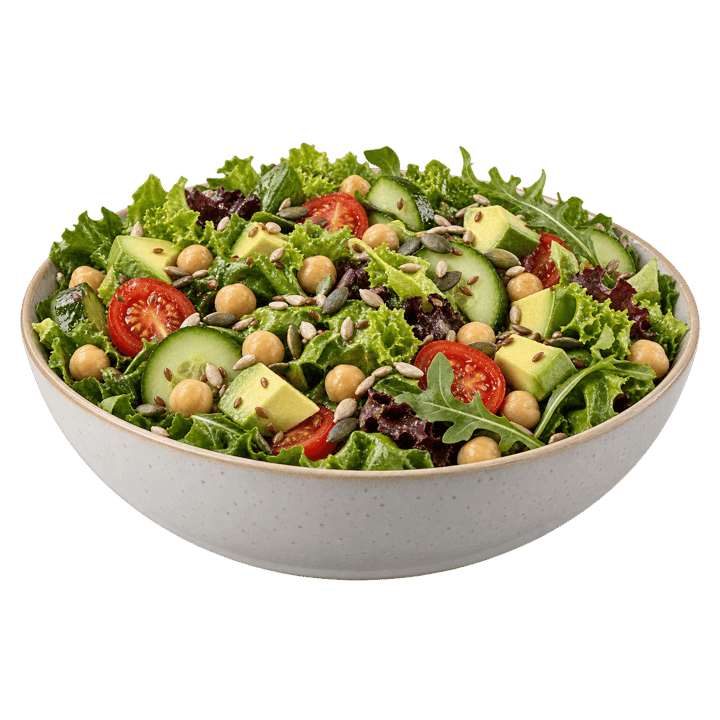
Leaves are half a meal: how to build a salad that's lunch
On this page
- Is a salad healthy?
- A meal has six jobs, and leaves do three
- Why you’re hungry by three
- The spoon that outweighs the bowl
- Keep the fat, since the color rides on it
- Build it for its job
- The salads people order, graded
- Which greens?
- Why are you here?
- What we know, and what we don’t
- The deep dives
- The simple plan
Leaves are half a meal. They do three of a meal’s six jobs very well, and they can’t do the other three, the ones that fill you up. A salad becomes lunch when you build the other half on top of them: your protein, a fiber food past the leaves, and a spoon of oil you measured. Before dinner, half a meal is the whole point, so there you keep it big and light.
What we’d do
Decide what the salad is for. When it’s the meal, give it a palm of chicken or fish or a can of tuna (about 30 g of protein for most people), half a cup of chickpeas, beans, corn or quinoa, and one or two tablespoons of olive oil with vinegar or lemon, poured into a spoon first. When it’s before a meal, make it a big bowl of leaves and crunchy vegetables with a teaspoon or so of oil.
Leave the fat on. A tablespoon of olive oil has more calories than a whole head of romaine, so measure it, but with fat-free dressing almost none of the color in your vegetables gets into your blood.
If you remember three things
- Leaves are the easy half. They’re real food, full of vitamins and gentle on blood sugar. They’re also mostly water, so they can’t fill you.
- The spoon outweighs the bowl. Three cups of romaine are about 24 calories. A quarter cup of ranch is about 256.
- Build it for its job. Big and light before a meal. Protein, fiber and a measured spoon of oil when it is the meal.
Is a salad healthy?
People order a salad to eat well, and they’re often half right. Gyroscope’s old A+ Meals guide said a salad “could range from an F to an A depending on what is in it”, and it still can. The leaves are the part you see, and they change the grade least.
At Penn State in 2004, Barbara Rolls and her team showed how far apart two salads can land. Forty-two women came in for lunch once a week. Most weeks lunch started with a salad they had to finish, and then they ate as much pasta as they wanted. A big, light salad cut the whole lunch, salad and pasta together, by 12%. The same size bowl made richer with more dressing and cheese raised it by 17%. The leaves and the bowl were the same, and the two lunches went in opposite directions.
A meal has six jobs, and leaves do three
Gyroscope grades every meal on six systems, and meals.guide has a page on each. A meal should fit your day, be mostly real food, bring enough protein, hold you until the next meal, bring minerals and vitamins for its calories, and keep your blood sugar steady. Put a bowl of leaves, tomato, cucumber and carrot with a spoon of olive oil through those six meters and it aces three of them.
 EnergyIs it the right size for your day?The toppings do this
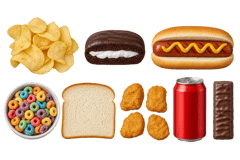 ProcessingIs it food, or a product made to be eaten fast?Leaves do this
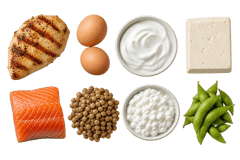 MuscleDoes it bring enough protein?The toppings do this
 HungerWill it hold you until the next meal?The toppings do this
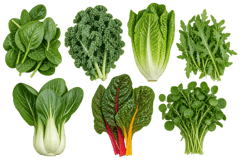 NutrientsMinerals and vitamins for its calories?Leaves do this
 GlucoseDoes it keep your blood sugar steady?Leaves do this
It’s all real food, so Processing is full. Leaves and carrots carry far more vitamin A, vitamin C and potassium than their calories would suggest, so Nutrients is full. There’s almost no fast carbohydrate in it, so Glucose is full. It misses the other three by a mile. Romaine is about 95% water and iceberg about 96%, so three cups of romaine come to about 24 calories and 3 g of protein. The whole bowl is around 200 calories with 5 g of protein, and that’s why it gets a C.


The garden salad
3 cups romaine, 1 tomato, ½ cup cucumber, ½ cup carrots, 1 tbsp olive oil, 1 tbsp vinegar
200 calories, 5 g protein, 6.5 g fiber, dressing 60%, sodium 40 mg

Add a palm of chicken
3 cups romaine, 1 tomato, ½ cup cucumber, ½ cup carrots, 1 palm chicken breast, 1 tbsp olive oil, 1 tbsp vinegar
340 calories, 32 g protein, 6.5 g fiber, dressing 35%, sodium 110 mg

And half a cup of chickpeas
3 cups romaine, 1 tomato, ½ cup cucumber, ½ cup carrots, 1 palm chicken breast, ½ cup chickpeas, 1 tbsp olive oil, 1 tbsp vinegar
480 calories, 39 g protein, 12.7 g fiber, dressing 25%, sodium 110 mg
Two additions take the same bowl from a C to an A+. The chicken does Muscle and most of Hunger, and the chickpeas finish Hunger with fiber and bring the bowl up to the size of a real meal. The leaves didn’t change at all. You can build your own and watch the meters fill.
Why you’re hungry by three
The three jobs leaves can’t do are the three that keep you full. A bowl of leaves at noon is a 150 to 200 calorie lunch with almost no protein, so being hungry by three isn’t a lack of willpower. Your body is asking for the rest of the meal.
Protein is the biggest part of it. A 2015 review of the research put the amount that helps with appetite and weight at about 25 to 30 g a meal or more, and that’s close to the meal line we use: 1.2 g per kg of body weight a day over your meals, about 30 g for a 170 lb person eating three times. A palm of chicken has about 27 g. A cup of romaine has about 1. Fiber is the second part, and three cups of romaine have only about 3 g, which is why something past the leaves (beans, corn, quinoa) does so much work. Why you’re hungry after a salad goes through it, protein on a salad has the routes with and without meat, and the protein ladder prices every salad protein in calories. The Gyroscope app personalizes your line.
A salad built this way can help you lose weight. In a year-long trial at Penn State, women told to eat less fat and more water-rich food, mostly vegetables and fruit, lost about 17 pounds (7.9 kg) against about 14 (6.4 kg) for women told only to eat less fat, and they said they were less hungry. Salad and weight loss has the rest.
The spoon that outweighs the bowl
A tablespoon of olive oil has about 119 calories, and a whole head of romaine, about a pound and a third of lettuce, has about 106.
The leaves are like packing peanuts in a shipping box. They fill most of the space and weigh almost nothing, and what you pack in with them decides the weight. A ladle of ranch on a side salad is about three quarters of its calories. Most people pour by eye, and the eye is generous. Cheese, croutons, nuts, bacon and dried fruit add up the same way, and toppings has the swaps that keep the crunch.
Bottled dressing also costs a meter. Ranch, caesar and most bottled vinaigrettes are ultra-processed, so when they’re a big share of a light bowl, the Processing meter drops. That’s why the classic salad with chicken and 2 tablespoons of ranch is a B. It misses Processing (the ranch is 39% of the bowl) and Energy (at about 325 calories it’s a little light to be lunch). Swap the ranch for a tablespoon of olive oil and vinegar and add half a cup of chickpeas, and it’s an A+. Dressing and the tablespoon problem has every dressing by the spoon, and the pour lets you slide from a teaspoon to a quarter cup.
Keep the fat, since the color rides on it
The orange in carrots and the red in tomatoes are carotenoids, and your body turns some of them into vitamin A. They don’t dissolve in water, only in fat. In 2004, researchers at Iowa State gave 7 people the same salad of spinach, romaine, cherry tomatoes and carrots with dressing made with 0, 6 or 28 g of canola oil, then measured what reached their blood. With the fat-free dressing, almost nothing did, and more oil meant more absorbed. In two later trials the amount of fat mattered more than the kind, and in 12 women given 0 to 32 g of oil, beta-carotene rose in a straight line from 0 to 8 g.
So this site’s bowl builder counts the vitamin A from vegetables only in proportion to the fat in the bowl, in full from 8 g. It’s the one rule we added to the six meters, and it’s why a fat-free dressing can’t beat a spoon of olive oil here. The fat can come from an egg, cheese, avocado or nuts too. The fat-free dressing myth has all three trials.
Build it for its job
The same bowl can be a good starter and a bad lunch. Before dinner, its job is to take up room for very few calories, so the light, big bowl from the Penn State trial is what you want, and the size, protein and hunger meters don’t apply. We don’t grade a starter. When the salad is the meal, it has to do all six jobs.
A rich starter does the opposite. In the trial, cheese, croutons and creamy dressing turned a 300 g starter into a bowl that made the whole lunch 17% bigger. Those were single lunches in a lab, and the women had to finish the salad, but the small and large rich salads both pushed lunch up. Starter or meal puts your bowl next to the trial’s, and salad before a meal covers what eating it first does to blood sugar too.
The salads people order, graded
Here are the salads people search for most, each with 2 tablespoons of dressing, graded as a meal. The side salad isn’t here, since it’s a starter.
- Taco saladclears all sixA+
- Cobb saladclears all sixA
- Salad with chickenmisses Energy and ProcessingB
- Chicken saladmisses Processing, Muscle and HungerC+
- Greek saladmisses Muscle and HungerC+
- Caesar saladmisses Processing, Muscle and HungerC
The taco salad comes out on top because it already has the other half built in, with beef and beans for protein, beans for fiber, and enough food to be a meal. The caesar without chicken comes last for the opposite reason. It has 10 g of protein, croutons where a fiber food should be, and a creamy dressing that’s 44% of its calories. The salads people order counts each one part by part, and the grade doesn’t count salt, so each page shows it beside the meters. If you buy lunch out, ordering a salad out has what to ask for at the counter.
Gyroscope’s meters also explain a result that surprises people. A quarter pound burger on whole wheat with lettuce, tomato and onion grades better than a side salad with cheddar and three spoons of ranch.


A burger on whole wheat
1⅓ palms ground beef, 2 slices whole wheat bread, 1 tomato, 1 cup romaine, ¼ cup onion
490 calories, 36 g protein, 6.9 g fiber, sodium 400 mg

A side salad with ranch
3 cups romaine, 3 tbsp ranch dressing, 1 oz cheddar cheese
330 calories, 11 g protein, 3 g fiber, dressing 58%, sodium 590 mg
Both clear Nutrients and Glucose. The burger wins Muscle, Hunger and Processing, since the bread is its only ultra-processed part and the ranch is more than half the salad’s calories. meals.guide runs that matchup with six more meals that grade the opposite of what you’d guess.
Which greens?
You can use any of them. Per cup, spinach has about three times the vitamin K of romaine, romaine has the most folate and vitamin A of the greens we compare, and kale wins on vitamin C by weight. Iceberg is mostly water but still counts, since two cups of any leafy green are one cup of vegetables in the US guidelines. Rotate them, since each brings a different mix. If you take warfarin, keep the amount of leafy greens steady week to week, since vitamin K changes how warfarin works, and talk to your doctor before a big change. Which greens? and greens compared have the numbers.
Why are you here?
People come to salad for different reasons, and the advice moves a little with each. Pick yours.
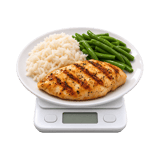 I count my caloriesThe leaves barely count. The dressing, cheese and protein set the total.
 I want to lose weightA salad helps when it's a real meal, and backfires by four when it isn't.
 I'm hungry an hour laterUsually short on protein and calories. Leaves are mostly water.
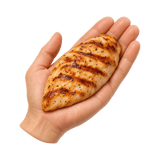 I need more proteinFrom tuna to cheese, what your meal line costs in calories.
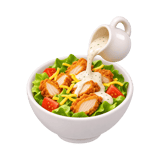 I can't stop drowning it in dressingHow much to pour, and why fat-free costs you the vitamins.
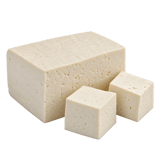 I don't eat meatTofu, eggs, cottage cheese, and beans with a partner.
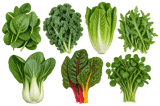 I want to eat more vegetablesOnly 1 in 10 US adults eats enough. A daily bowl is the easy way in.
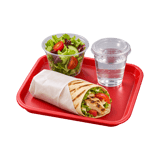 I buy lunch outA protein you can see, beans or corn, and the dressing on the side.
 I watch my blood sugarEating the salad before the carbs, and what the trials found.
 I'm on a GLP-1A smaller bowl, the protein first, and less raw roughage early on.
 Salad makes me bloatedWhich parts make gas, and how to build up to a big bowl.
 I take warfarinKeep your greens steady week to week, and why.
What we know, and what we don’t
We’re confident that leaves alone can’t fill you, that protein and fiber are what make a salad a meal, and that a salad’s dressing and toppings decide most of its calories. Those come from food tables anyone can check and from feeding trials that point the same way.
The evidence on the rest is good but smaller. The Iowa State dressing study had 7 people, and it measured what reached their blood after one meal, not whether anyone got healthier. The Penn State lunches were single meals in a lab. The year-long weight trial was in women with obesity, and about a quarter dropped out. The 2015 protein review found people felt fuller after higher-protein meals but didn’t always eat less at the next one. Nobody has run a long trial of a daily meal salad, so we don’t know yet how much of the benefit is the salad and how much is everything else a salad person does. As of November 2026 we’d still build it this way, since the cost is a can of chickpeas and a spoon of oil.
The deep dives
- The salad that’s a meal. The four parts that turn a bowl of leaves into lunch, and five salads graded on the six meters.
- Dressing and the tablespoon problem. Calories by the spoon, why fat-free costs you the vitamins, and how much to pour.
- Protein on a salad. The ladder from tuna to cheese, and how to get there without meat.
- Toppings: the crunch that adds up. The extras that pile on calories, and the swaps that fill you instead.
- Which greens? Spinach, kale, romaine and iceberg by the cup and by weight, and warfarin.
- Salad before a meal. When a starter makes you eat less, when it makes you eat more, and blood sugar.
- Salad and weight loss. The year-long trial, and why a bowl of leaves at lunch backfires by four.
- Ordering a salad out. What to look for on the menu and what to ask for at the counter.
- Salad on a GLP-1. A smaller bowl, the protein first, and less raw roughage early on.
The simple plan
- Decide the job. Before dinner, a starter. At lunch or as dinner, a meal. You don’t need a supplement, a greens powder or an app for any of this, only a bowl, a spoon and food you like.
- For a starter, fill a big bowl with leaves and crunchy vegetables and use a teaspoon or so of oil. Skip the cheese and croutons.
- For a meal, put your protein on the leaves (a palm of chicken or fish, a can of tuna, or two eggs with a cup of beans), add half a cup of chickpeas, beans, corn or quinoa, and dress it with one or two tablespoons of olive oil and vinegar.
- Measure the dressing once. Pour your usual amount into a tablespoon. After that you’ll know what your drizzle really is.
- Rotate the greens every week or two, and keep them steady if you take warfarin.
- Track it for two weeks. Photograph your salad before you eat, add how much dressing went on, and Gyroscope gives you the calories, protein and a grade in seconds. If you only ate half, change the portion after. The photo log with a grade is free with Food XRAY, and Gyroscope One adds vitamins and minerals and the coach who sees your meals. Note when you’re hungry again.
- Fix one thing at a time. If the grade isn’t an A, take the one change the builder suggests, and watch three o’clock.
15 sources
- Rolls, Roe and Meengs, Salad and satiety: energy density and portion size of a first-course salad affect energy intake at lunch, Journal of the American Dietetic Association, 2004pubmed.ncbi.nlm.nih.gov
- Brown et al., Carotenoid bioavailability is higher from salads ingested with full-fat than with fat-reduced salad dressings as measured with electrochemical detection, American Journal of Clinical Nutrition, 2004pubmed.ncbi.nlm.nih.gov
- White et al., Modeling the dose effects of soybean oil in salad dressing on carotenoid and fat-soluble vitamin bioavailability in salad vegetables, American Journal of Clinical Nutrition, 2017pubmed.ncbi.nlm.nih.gov
- Goltz et al., Meal triacylglycerol profile modulates postprandial absorption of carotenoids in humans, Molecular Nutrition and Food Research, 2012pubmed.ncbi.nlm.nih.gov
- Ello-Martin et al., Dietary energy density in the treatment of obesity: a year-long trial comparing 2 weight-loss diets, American Journal of Clinical Nutrition, 2007pubmed.ncbi.nlm.nih.gov
- Leidy et al., The role of protein in weight loss and maintenance, American Journal of Clinical Nutrition, 2015pubmed.ncbi.nlm.nih.gov
- Lee et al., Adults meeting fruit and vegetable intake recommendations, United States, 2019, MMWR, 2022cdc.gov
- US Department of Agriculture and US Department of Health and Human Services, Dietary Guidelines for Americans, 2025 to 2030, January 2026cdn.realfood.gov
- USDA, Daily servings by calorie level, 2025 to 2030cdn.realfood.gov
- Gebhardt and Thomas, Nutritive Value of Foods, Home and Garden Bulletin 72, USDA Agricultural Research Service, 2002ars.usda.gov
- USDA Standard Reference, lettuce, cos or romaine, raw (1 head = 626 g)nutritionvalue.org
- USDA Standard Reference, lettuce, iceberg, rawnutritionvalue.org
- MedlinePlus, Warfarin, US National Library of Medicinemedlineplus.gov
- meals.guide, Every meal is a supply run (the six meters) and The burger that beat the salad, 2026-11-15meals.guide
- Gyroscope, Food XRAYgyrosco.pe