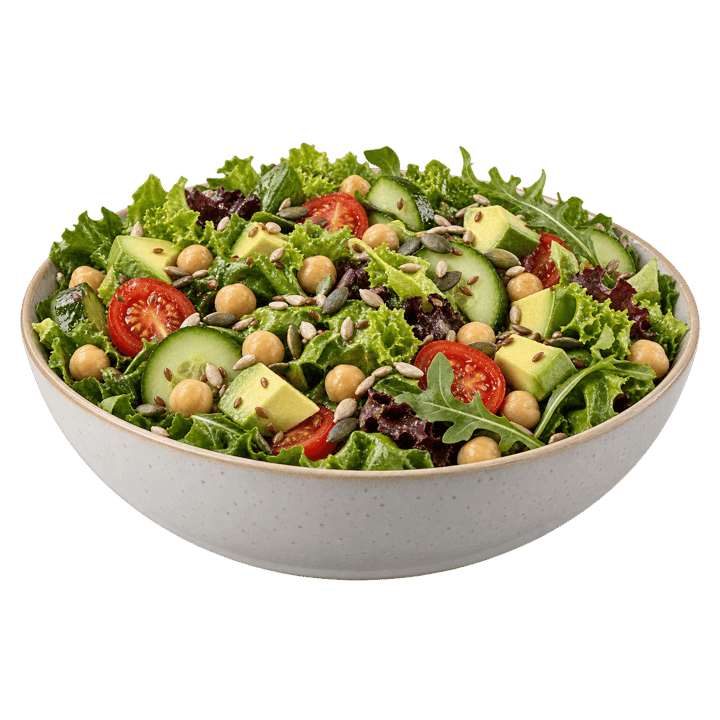
Dressing and the tablespoon problem
On this page
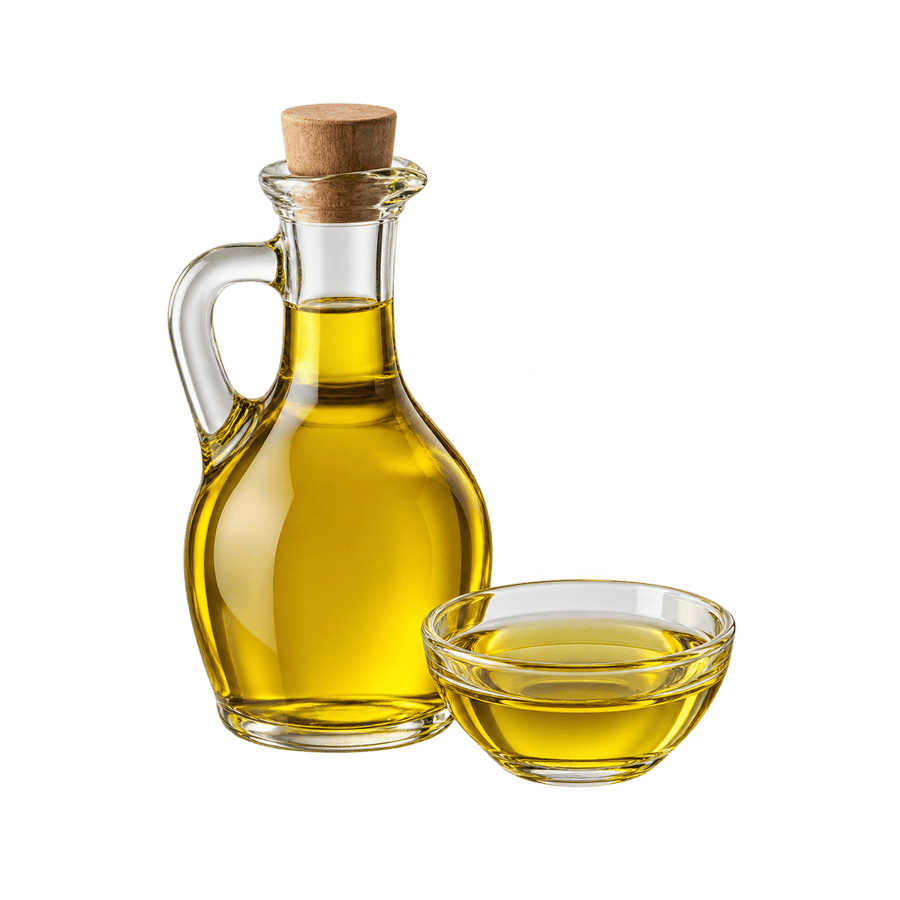
Use one to two tablespoons of an oil-based dressing on a salad that’s your meal, and measure it with a spoon. The fat carries the vitamins in the vegetables into your blood, so fat-free costs you most of them, and every tablespoon past two adds about 60 to 120 calories.
What we’d do
Make your own, with a tablespoon of olive oil and vinegar or lemon on a meal salad, or two if it’s a big bowl. Pour it into a measuring spoon for the first week, until your eye knows what a tablespoon looks like on your leaves. Skip fat-free dressing. If you love ranch or caesar, have it on the side and dip, so you decide how much goes on.
If you remember three things
- A tablespoon of olive oil has more calories than a whole head of romaine. About 119 against about 106.
- With fat-free dressing, almost none of the beta-carotene gets in. In a 2004 study, 7 people absorbed close to nothing from the same salad until the dressing had oil in it.
- The amount of fat counted more than the kind. Canola, soybean oil and butter all worked, and more worked better.
Two ways to get dressing wrong
There are two common mistakes, and they go in opposite directions.
The first is pouring by eye. A ladle at a salad bar or a 2 oz cup on the side holds about 4 tablespoons, since a fluid ounce is 2 tablespoons. That’s about 256 calories of ranch, 320 of caesar or 476 of olive oil, on top of leaves that might come to 30.
The second is buying fat-free to be good. It does save calories, and it also means you absorb almost none of the carotenoids in the carrots, tomatoes and spinach you just ate. Both mistakes come from treating dressing like a garnish, when it’s the biggest number in a lot of salads.
Dressing is like salt in cooking. A dish needs some to work, and the right amount is much smaller than what comes out when you pour without measuring.
Calories by the spoon
| Dressing | 1 tbsp | 2 tbsp | 4 tbsp, a ladle | Fat in 1 tbsp | Sodium in 1 tbsp |
|---|---|---|---|---|---|
| Olive oil | 119 | 238 | 476 | 14 g | 0 mg |
| Olive oil and vinegar, 3 to 1 | 90 | 180 | 360 | 10.5 g | 0 mg |
| Caesar | 80 | 160 | 320 | 8.5 g | 178 mg |
| Blue cheese | 77 | 154 | 308 | 8 g | 167 mg |
| Italian, bottled | 69 | 138 | 276 | 7 g | 116 mg |
| French | 67 | 134 | 268 | 6 g | 214 mg |
| Ranch | 64 | 128 | 256 | 6.7 g | 135 mg |
| Thousand island | 59 | 118 | 236 | 6 g | 109 mg |
| Light Italian | 16 | 32 | 64 | 1 g | 118 mg |
| Lemon juice | 3 | 6 | 12 | 0 g | 3 mg |
| Cider vinegar | 2 | 4 | 8 | 0 g | 0 mg |
The olive oil tops the table because it’s pure fat. Bottled dressings are part water and vinegar, so a tablespoon of ranch has about half the calories of a tablespoon of oil. Olive oil also has more calories than butter, at 119 a tablespoon against 102, for the same reason, since butter is part water too.
A tablespoon is 15 ml, and olive oil comes to about 8 calories a ml. A whole head of romaine, 626 g of it, has about 106 calories, so a single tablespoon of oil beats the whole head. You can try it yourself on the pour, which slides from a teaspoon to a quarter cup and shows the dressing’s share of your bowl.
Why fat-free costs you the vitamins
The orange in carrots is beta-carotene, and the red in tomatoes is lycopene. They’re carotenoids, and they dissolve in fat but not in water. Vitamin K in the leaves and vitamin A behave the same way.
- The color starts inside the vegetable. Chewing and digestion free some of it in your gut.
- It needs fat to move. In your gut, the carotenoids mix into the fat from the meal.
- Your gut ships fat in small packages. The cells lining your intestine pack fat into particles called chylomicrons and send them into your blood through the lymph.
- The color rides along. Whatever carotenoids mixed into the fat go with it. With almost no fat in the meal, almost none of them make the trip.
The researchers in all three studies below measured that last step, the carotenoids turning up in chylomicrons in the hours after the salad.
What the studies found
Fat-free, reduced-fat and full-fat
7 people, Iowa State University, 2004. Brown and colleagues
Each person ate the same salad of spinach, romaine, cherry tomatoes and carrots three times, with dressing made with 0, 6 or 28 g of canola oil. With the fat-free dressing, the researchers found “essentially no absorption of carotenoids”. More oil gave more.
Seven people, one meal each, and it measured absorption, not health.
The amount against the kind
29 adults, 2012. Goltz and colleagues
Salads came with 3, 8 or 20 g of canola oil, soybean oil or butter. Twenty grams raised absorption over 3 and 8 g for every carotenoid but alpha-carotene. The amount of fat had a bigger effect than which fat it was. Canola trended a little above butter for two carotenoids, and that gap was too small to be sure of.
One meal per test, absorption only.
From none to more than two spoons
12 women, 2017. White and colleagues
Each ate five salads with 0, 2, 4, 8 or 32 g of soybean oil in the dressing. Alpha-carotene, lycopene, vitamin K and a form of vitamin A rose in a straight line with the oil, all the way to 32 g. Beta-carotene rose up to 8 g, and lutein and vitamin E up to 4 g.
Twelve women, and 32 g is more oil than most people pour.
Why our line is one to two tablespoons
One tablespoon of olive oil is 14 g of fat, and two are 28 g. Two tablespoons match the full-fat dressing that worked in the Iowa State study, and one sits between Goltz’s 8 g and 20 g amounts. In White’s trial some vitamins kept climbing past that, up to 32 g, which is about two and a third tablespoons. We still stop at two, since each extra spoon of oil is another 119 calories, and two spoons of oil are already about 40% of the calories in our lunch bowl.
For a starter before dinner, go lighter. A teaspoon to a tablespoon is enough fat to carry the color, and salad before a meal explains why a light starter helps and a rich one backfires.
Does the kind of oil make a difference?
For absorbing the vitamins, the amount counts more than the kind, and Goltz’s team found butter worked too. For the rest of your health, the 2025 to 2030 US guidelines say to “prioritize oils with essential fatty acids, such as olive oil” when you add fat to meals. A tablespoon of olive oil has about 9.9 g of monounsaturated fat and 1.8 g of saturated, and it’s the base we’d use. Canola works the same way in the bowl.
Watch the salt in bottled dressings
Olive oil and vinegar have no sodium. A tablespoon of caesar has 178 mg, and French 214. A caesar with 3 tablespoons of dressing, croutons and parmesan comes to about 1,080 mg, close to half the 2,300 mg Daily Value on a food label. If your blood pressure is high, bloodpressure.guide explains why salt raises it.
The best case for fat-free
“Fat has the most calories, and I’m trying to lose weight.” That’s a real trade. Two tablespoons of light Italian are about 32 calories, and two of olive oil are 238, so fat-free saves about 200 calories a bowl. On our lunch bowl, swapping the tablespoon of oil for 2 tablespoons of light Italian drops it from about 453 to 364 calories.
But you’d be paying for vegetables and throwing away the part that makes them colorful. We’d keep one tablespoon of oil, add as much vinegar or lemon as you like for volume and taste, and save the calories somewhere else, like the croutons or the second scoop of cheese.
10 sources
- Brown et al., Carotenoid bioavailability is higher from salads ingested with full-fat than with fat-reduced salad dressings as measured with electrochemical detection, American Journal of Clinical Nutrition, 2004pubmed.ncbi.nlm.nih.gov
- Goltz et al., Meal triacylglycerol profile modulates postprandial absorption of carotenoids in humans, Molecular Nutrition and Food Research, 2012pubmed.ncbi.nlm.nih.gov
- White et al., Modeling the dose effects of soybean oil in salad dressing on carotenoid and fat-soluble vitamin bioavailability in salad vegetables, American Journal of Clinical Nutrition, 2017pmc.ncbi.nlm.nih.gov
- Gebhardt and Thomas, Nutritive Value of Foods, Home and Garden Bulletin 72, USDA Agricultural Research Service, 2002 (items 152, 176, 189, 193, 195, 196, 202, 315, 1270)ars.usda.gov
- USDA Standard Reference, oil, salad or cooking, olivenutritionvalue.org
- USDA Standard Reference, salad dressing, ranch dressing, regularnutritionvalue.org
- USDA Standard Reference, salad dressing, caesar dressing, regularnutritionvalue.org
- USDA Standard Reference, lettuce, cos or romaine, raw (1 head = 626 g)nutritionvalue.org
- US Department of Agriculture and US Department of Health and Human Services, Dietary Guidelines for Americans, 2025 to 2030cdn.realfood.gov
- US Food and Drug Administration, Daily Value on the Nutrition and Supplement Facts labelsfda.gov