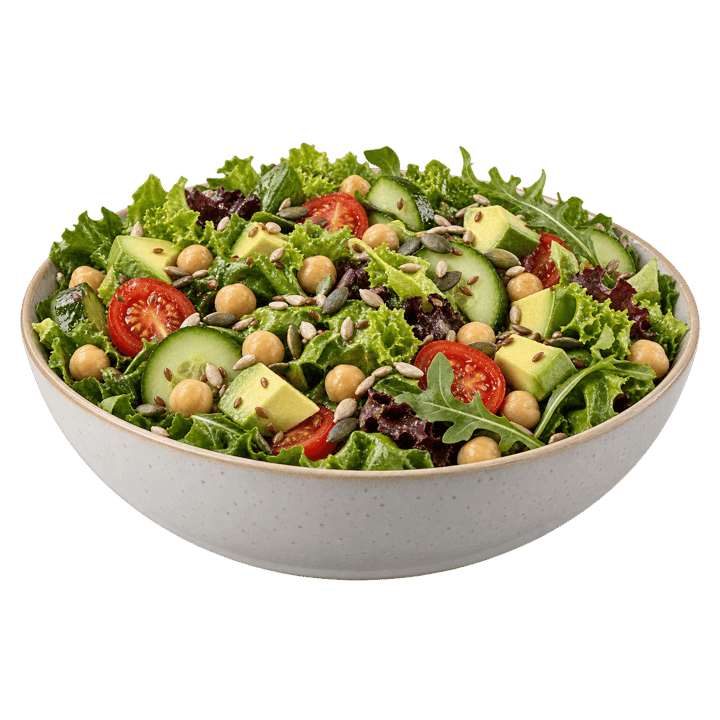
Is a 400-calorie salad enough for lunch?
It can be, if it carries your protein line and some fiber. On a 2,000 calorie day over three meals, a meal runs about 500 to 830 calories, so 400 is a little small for most people. A 400 calorie bowl of romaine, tuna, chickpeas and olive oil holds you far longer than a 360 calorie caesar.
People trying to lose weight tend to treat lunch as the place to save. The smaller the number, the better it feels. But a lunch that’s too small is a common reason people are hungry by three, and what’s in the 400 decides whether you make it to dinner.
What we’d do
Size lunch to your day instead of to a round number. Split your day’s calories over your meals and stay within about a quarter either side. Then make sure the bowl has your protein line and something with fiber past the leaves, like beans, corn or a grain. If you’re eating less to lose weight, 400 can be a good lunch. If it’s a 400 calorie bowl of leaves and dressing, it won’t last.
Two salads with almost the same calories can be completely different meals.
| Salad | Calories | Protein | Fiber | Grade |
|---|---|---|---|---|
| 3 cups romaine, 3 oz tuna, half a cup of chickpeas, a tomato, a tablespoon of olive oil | 403 | 34 g | 10.7 g | A |
| Caesar with 2 tablespoons of dressing, an ounce of croutons and parmesan | 360 | 10 g | 4.4 g | C |
The caesar’s calories are mostly dressing, croutons and cheese. The tuna bowl’s are protein, beans and a spoon of oil. The one change our bowl builder suggests for the tuna bowl is half a cup of black beans, which makes it an A+ at about 520.
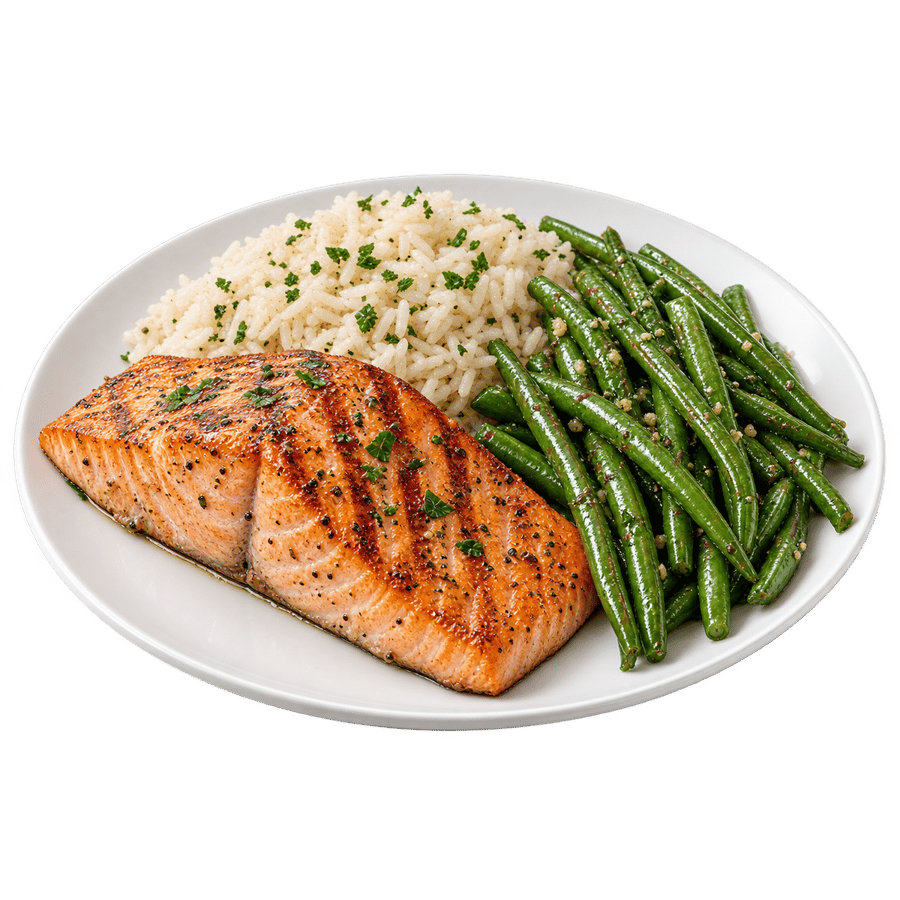
How big should lunch be?
Take your day’s calories, divide by your meals, and allow about a quarter either way. That’s the window the Energy meter uses, on meals.guide and in our bowl builder.
| Your day | Three meals | Lunch window |
|---|---|---|
| 1,500 calories | 500 each | about 375 to 625 |
| 1,800 | 600 each | about 450 to 750 |
| 2,000 | 670 each | about 500 to 830 |
| 2,500 | 830 each | about 625 to 1,040 |
These are typical ranges. The Gyroscope app personalizes yours. If you don’t know your day’s calories, tdee.guide works them out from your size and steps.
Protein is the other half. Our line is 1.2 g per kg of body weight a day, the low end of the US guideline’s 1.2 to 1.6, split over your meals. That’s about 25 g a meal at 140 lb, 30 g at 170 and 35 g at 200.
Why the calories alone don’t decide it
A 2015 review of the protein research found that people felt fuller after higher-protein meals, and put the useful amount at about 25 to 30 g a meal or more. They didn’t eat less at the next meal in those short trials, so the effect is modest, but it’s the part of lunch you’ll feel at three.
Volume helps too. In a year-long Penn State trial, 97 women with obesity were told to eat less fat, and half of them were also told to eat more water-rich food, mostly fruit and vegetables. Neither group had a calorie target. Of the 71 who finished, the vegetable group ate a greater weight of food, lost 17.4 lb (7.9 kg) against 14.1 lb (6.4 kg), and said they were less hungry. A big bowl of greens is how a salad does that.
Try yours
Put your usual lunch into the bowl builder with your weight and meals. If it’s under the window, the one change usually adds protein or beans. If you’re often hungry by mid-afternoon, why am I hungry after a salad goes through the usual reasons.
5 sources
- Gebhardt and Thomas, Nutritive Value of Foods, Home and Garden Bulletin 72, USDA Agricultural Research Service, 2002ars.usda.gov
- USDA Standard Reference, salad dressing, regular, caesarnutritionvalue.org
- US Department of Agriculture and US Department of Health and Human Services, Dietary Guidelines for Americans, 2025 to 2030cdn.realfood.gov
- Leidy et al., The role of protein in weight loss and maintenance, American Journal of Clinical Nutrition, 2015pubmed.ncbi.nlm.nih.gov
- Ello-Martin et al., Dietary energy density in the treatment of obesity: a year-long trial comparing 2 weight-loss diets, American Journal of Clinical Nutrition, 2007pubmed.ncbi.nlm.nih.gov