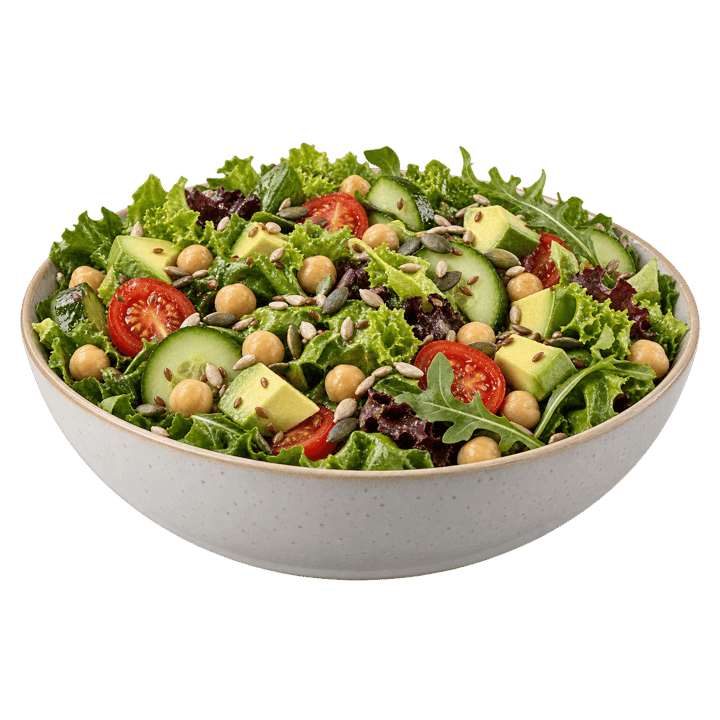
What should I put in my salad?
Greens, a protein to your line, something with fiber past the leaves like beans, corn or a grain, some crunchy vegetables, and a tablespoon of olive oil with vinegar or lemon. Our version comes to about 450 calories with 39 g of protein and 11 g of fiber, and it grades A+.
Most people build a salad from whatever looks fresh and healthy, and the “healthy” toppings are where it goes wrong. Avocado, almonds, dried cranberries, feta and a bottled vinaigrette each sound good. On 3 cups of romaine, with 2 oz of avocado, an ounce each of almonds and feta, a quarter cup of cranberries and 2 tablespoons of dressing, they make a bowl of about 700 calories. Seven in ten of those calories are fat, the cranberries bring 25 g of added sugar, and there’s only 17 g of protein. The other common miss is the bowl of leaves with nothing else, which is about 140 calories and gone by mid-afternoon.
What we’d do
Build it in five parts, starting with a big base of greens, then your protein, one food with fiber, color and crunch, and a spoon of oil last. Three cups of romaine, a palm of grilled chicken, half a cup of chickpeas, a tomato, half a cup of cucumber and a tablespoon of olive oil with vinegar is the bowl we’d make most days. Swap the parts for what you like, but keep all five.
A meal salad is a dinner plate in a bowl. It has the same parts, a protein, a starch or beans, vegetables and a little fat, and the leaves take the place of the vegetables on the side.
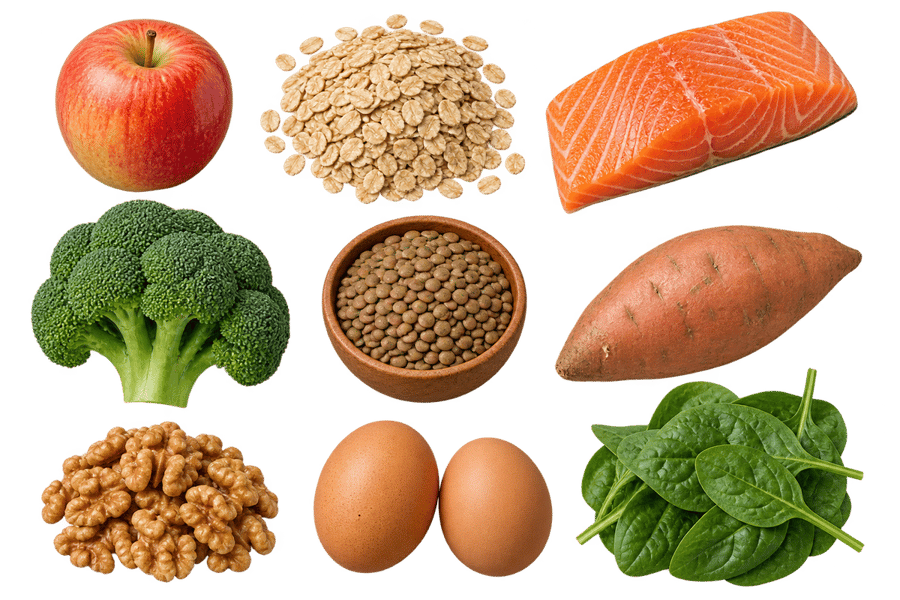
The five parts
| Part | How much | Good picks, with calories |
|---|---|---|
| Greens | 3 to 4 cups | Romaine (8 a cup), spinach (7), any mix |
| Protein | your line, about 30 g at 170 lb | A palm of chicken, 3 oz (140, 27 g of protein). A 3 oz can of tuna (99, 22 g). Two eggs (156, 12 g). A cup of cottage cheese (217, 26 g) |
| Fiber past the leaves | half a cup | Chickpeas (134, 6.2 g of fiber). Black beans (114, 7.5 g). Corn (66, 2 g). Quinoa (111, 2.6 g) |
| Color and crunch | as much as you like | A tomato (26), half a cup of cucumber (7), a cup of bell pepper (40), carrots |
| Fat | 1 tablespoon | Olive oil (119) with vinegar or lemon. Or an ounce of avocado (50) with a smaller pour |
The protein line is 1.2 g per kg of body weight a day split over your meals, about 25 g at 140 lb, 30 at 170 and 35 at 200. These are typical ranges. The Gyroscope app personalizes yours, and the protein ladder shows how much of each food gets you there.
Why each part is there
The greens are volume for almost no calories, and two cups of leafy greens count as a cup of vegetables in the US guidelines. The protein is what makes a meal feel filling. A 2015 review of the research put the helpful amount at about 25 to 30 g a meal or more. The beans, corn or grain add the fiber that leaves don’t have much of, plus more protein in the beans. The vegetables add color and crunch for very few calories.
The fat is the part people leave out, and it does a real job. At Iowa State in 2004, 7 people ate the same salad of spinach, romaine, cherry tomatoes and carrots three times, with dressing made with 0, 6 or 28 g of canola oil. With the fat-free dressing, the beta-carotene and lycopene from the vegetables barely showed up in their blood at all. With more oil, more got in. It was a small study, but two later trials also found that more oil meant more absorbed.
What to go easy on
Croutons, candied nuts, dried fruit, bacon bits and creamy dressing by the ladle. None of them is banned, but each adds about 90 to over 300 calories with little protein or fiber. The swaps that keep the crunch are chickpeas for croutons, plain almonds for candied ones and a cup of strawberries for the dried cranberries.
Put your own bowl into the bowl builder. It grades it on the six meters Gyroscope grades a meal on and tells you the one change that would lift it most.
7 sources
- Gebhardt and Thomas, Nutritive Value of Foods, Home and Garden Bulletin 72, USDA Agricultural Research Service, 2002ars.usda.gov
- USDA Standard Reference, oil, salad or cooking, olivenutritionvalue.org
- Brown et al., Carotenoid bioavailability is higher from salads ingested with full-fat than with fat-reduced salad dressings as measured with electrochemical detection, American Journal of Clinical Nutrition, 2004pubmed.ncbi.nlm.nih.gov
- Leidy et al., The role of protein in weight loss and maintenance, American Journal of Clinical Nutrition, 2015pubmed.ncbi.nlm.nih.gov
- Goltz et al., Meal triacylglycerol profile modulates postprandial absorption of carotenoids in humans, Molecular Nutrition and Food Research, 2012pubmed.ncbi.nlm.nih.gov
- White et al., Modeling the dose effects of soybean oil in salad dressing on carotenoid and fat-soluble vitamin bioavailability in salad vegetables, American Journal of Clinical Nutrition, 2017pmc.ncbi.nlm.nih.gov
- Daily Servings by Calorie Level, Dietary Guidelines for Americans, 2025 to 2030cdn.realfood.gov