How do I make a salad more filling?
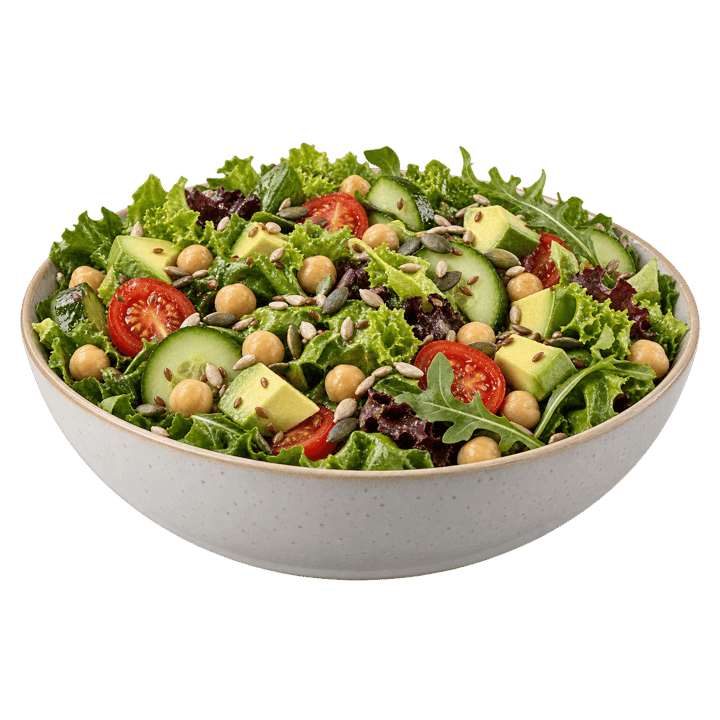
Add your protein line, half a cup to a cup of beans or a grain, and a tablespoon of olive oil. That’s what turns a side salad into a meal. A bowl of leaves with a spoon of dressing is about 140 calories and 6 g of protein, and the same bowl with chicken, chickpeas and oil is about 465 calories, 40 g of protein and 13 g of fiber.
When a salad leaves people hungry, the usual fix is a bigger salad, and they reach for more lettuce. More lettuce makes the bowl look fuller and adds almost nothing, since four more cups of romaine are about 32 calories and 4 g of protein.
What we’d do
Add three things, in this order. First your protein (a palm of chicken or fish, a can of tuna, two or three eggs, or cottage cheese). Then one food with fiber and some starch, like half a cup of chickpeas, black beans, corn or quinoa. Then a tablespoon of olive oil with vinegar if the bowl doesn’t have one. Keep the big pile of greens underneath for the volume and the vegetables.
Adding more lettuce to a salad that leaves you hungry is like adding more ice to a drink that’s too small.
What each add brings
| Add | Calories | Protein | Fiber |
|---|---|---|---|
| A palm of grilled chicken, 3 oz | 140 | 27 g | 0 |
| A 3 oz can of tuna | 99 | 22 g | 0 |
| Two hard-cooked eggs | 156 | 12 g | 0 |
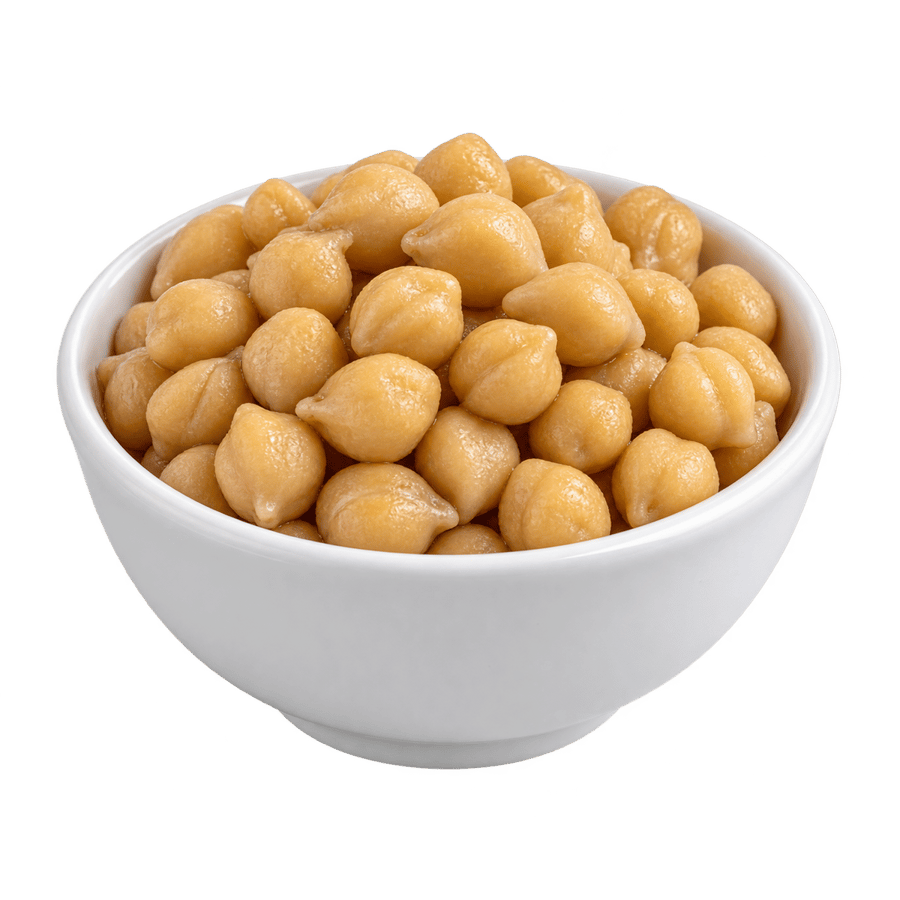
| Half a cup of chickpeas | 134 | 7.5 g | 6.2 g |
| Half a cup of black beans | 114 | 7.5 g | 7.5 g |
| Half a cup of cooked quinoa | 111 | 4 g | 2.6 g |
| Half a cup of corn | 66 | 2.5 g | 2 g |
| A tablespoon of olive oil | 119 | 0 | 0 |
| Two more cups of romaine | 16 | 2 g | 2 g |
The chicken does the most per calorie. The beans are the only add that brings both protein and fiber.
Why these three
Protein. A 2015 review of the protein research found people felt fuller after higher-protein meals, with about 25 to 30 g a meal or more as the helpful amount. People didn’t eat less at the next meal in those short trials, but protein is the add with the best evidence for feeling full.
Beans or a grain. Half a cup of chickpeas gives you 6 g of fiber and 7.5 g of protein for 134 calories, more fiber than three cups of romaine.
Fat. A salad with no fat costs you most of the carotenoids in the vegetables. In a 2004 Iowa State study, almost no beta-carotene reached the blood of people who ate a salad with fat-free dressing. A tablespoon of olive oil fixes that for 119 calories.
Bigger and lighter beats smaller and richer
Volume still helps. At Penn State, 42 women ate salads of different sizes and richness before a pasta lunch. When two salads had the same calories, the bigger, lighter one cut the whole lunch more than the smaller, richer one. And in a year-long trial of 97 women, the group told to eat more water-rich foods like vegetables lost 17.4 lb (7.9 kg) against 14.1 lb (6.4 kg) and said they were less hungry.
The way to use that is a big bowl of greens with real food on top, and the dressing measured.
Try it
Put your usual salad into the bowl builder. If it’s short, the one change it suggests is usually one of the adds above. The protein ladder shows which protein reaches your line for the fewest calories.
5 sources
- Gebhardt and Thomas, Nutritive Value of Foods, Home and Garden Bulletin 72, USDA Agricultural Research Service, 2002ars.usda.gov
- Leidy et al., The role of protein in weight loss and maintenance, American Journal of Clinical Nutrition, 2015pubmed.ncbi.nlm.nih.gov
- Rolls, Roe and Meengs, Salad and satiety: energy density and portion size of a first-course salad affect energy intake at lunch, Journal of the American Dietetic Association, 2004pubmed.ncbi.nlm.nih.gov
- Ello-Martin et al., Dietary energy density in the treatment of obesity: a year-long trial comparing 2 weight-loss diets, American Journal of Clinical Nutrition, 2007pubmed.ncbi.nlm.nih.gov
- Brown et al., Carotenoid bioavailability is higher from salads ingested with full-fat than with fat-reduced salad dressings as measured with electrochemical detection, American Journal of Clinical Nutrition, 2004pubmed.ncbi.nlm.nih.gov